

They were built for a slower, more predictable world and don’t match how managers actually work now.
Manager effectiveness programs assumed managers could step away from work for workshops, fill out a workbook, pass a quiz, and walk out "certified." That model does not match how work happens in large, always-on organizations.
Today, managers live inside Slack, Teams, email, and back-to-back meetings. Decisions get made in channels, not in classrooms. Tough feedback happens in DMs, not in case studies. Yet training still shows up as quarterly workshops and long LMS modules that sit outside the flow of work. There is a clear gap between where managers spend their time and where development lives.
Static competency models add to the problem. A neat PDF of traits might have made sense when org structures stayed stable. Now a VP of Engineering can see three reorgs in a year, carry a hybrid team across time zones, and handle constant priority shifts. A one-time certification from last year does not say much about how that leader is showing up today.
Traditional “cascade” models also struggle. We train a small group of high-potential managers and hope they pass it down. In reality, most of that learning stays trapped in slide decks or in a few people’s heads. The rest of the manager population keeps guessing.
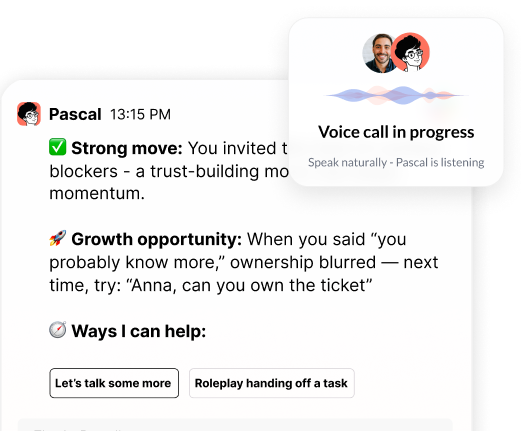
As AI becomes available inside the flow of work, the base assumption changes. Coaching no longer has to be an event. When AI sits directly in Slack, Teams, and live meetings, coaching can show up in real time, right in the moment a manager is writing a message, planning a 1:1, or leading a tough discussion. Instead of asking managers to go to learning, learning shows up where they already are, without another standalone app or course library to juggle.
It shifts competencies from abstract traits to concrete, observable behaviors in real work situations.
AI coaching does not just make old competency models faster. It changes what “good” even means. The focus moves from abstract traits to clear, observable behaviors in real situations.
Traditional models say things like “strategic thinker” or “strong communicator.” Helpful, but fuzzy. With AI in the flow of work, we can define the behavior instead of the label, like “frames tradeoffs clearly in the planning channel before decisions” or “checks for understanding at the end of a 1:1.” That is something we can actually see and coach in the moment.
When AI is present in Slack or Teams, it can respond to specific situations, such as:
In each case, AI can offer a quick nudge, a better phrasing option, or a short role-play before the real conversation.
Competency models also stop being static documents. They turn into living playbooks that are updated based on what is happening. For example, we can see how often managers clarify expectations before delegating, or how they open performance conversations, and adjust guidance based on what works across teams.
New kinds of competencies start to matter:
Because these are grounded in actual messages and meetings, the manager effectiveness program becomes more evidence-based. Instead of generic leadership labels, we anchor on patterns in real communication and real behavior.
Certification becomes behavior-based and ongoing instead of a one-time completion badge.
If coaching is always available, certification cannot be a one-and-done badge. It needs to reflect behavior over time, not just “attended a workshop” or “clicked through a module.”
Current manager certifications are often:
With AI in the flow of work, we can shift to continuous, behavior-based certification. The AI can observe patterns like how a manager runs 1:1s over several months, or how they follow up after performance feedback. From there, we can create micro-certifications tied directly to your manager effectiveness program, such as:
Since many companies review talent and promotion readiness around mid-year, this becomes especially useful. You can look at behavior data from the first half of the year to inform who is truly “certified” to take on a larger team, lead a reorg, or step into a succession role.
Think of a regional sales director who receives AI nudges before pipeline reviews for a few months. The AI supports better questions, clearer accountability, and real follow-through. Instead of a badge for attending a training, that leader earns a “Coaching Conversations” designation based on a consistent pattern of improved behavior.
For HR and L&D, certification becomes a lens for advanced development, not a checkbox to repeat every year. You can see who has mastered the basics and focus human-led time on higher-level skills and strategic challenges.
Internal trainers shift from basic content delivery to designing, curating, and targeting AI-supported development.
AI does not replace internal facilitators or coaches. It changes where their energy goes. Instead of spending most of their time on basic skills delivery, trainers can move into more strategic, creative work that AI alone cannot do.
The old role often looked like:
In an AI-coached setup, the role shifts toward:
For example, an L&D business partner might stop leading generic “difficult conversations” sessions several times a quarter. Instead, they pull real patterns from the engineering org, build them into Pascal’s scenario library, and then run a small lab that focuses only on the truly messy conversations where humans need to practice together.
In this model, trainers spend less time repeating the same content and more time designing experiences, shaping the AI, and advising HR and business leaders on what managers really need.
You translate what already works into in-the-flow coaching moments and design around real behaviors instead of courses.
Rebuilding your manager effectiveness program does not mean throwing everything out. It means taking what already works and making sure it shows up at the right moments in the flow of work.
Start by taking inventory:
Then ask, “Which moments should this show up in?” For example, your feedback model should appear when a manager writes a review, prepares a tough conversation, or reacts to a missed deadline, not only during a classroom session.
Next, map these moments to real-time triggers that Pascal can support. That could be:
Reframe content from big modules to small coaching moves. Instead of a 60-minute class on prioritization, create ten short nudges, questions, and role-play prompts that the AI can surface in seconds.
Mid-year is a strong time to run a focused pilot. Pick a narrow set of behaviors you want all managers to show in mid-year reviews, like setting clear expectations and asking open questions, then embed AI coaching around those exact moves.
To see if the new program is working, track leading indicators such as:
Completion rates matter less. What counts is how people behave in real work.
You make AI coaching the always-available backbone of manager development while keeping humans focused on the highest-value interactions.
The companies that get the most from AI coaching treat it as the backbone of their manager effectiveness program, not an optional add-on. They use it to shape competencies, inform certification, and redefine trainer roles over a full year, while keeping human leaders and coaches front and center for the most complex, sensitive work.
A simple 12-month roadmap might look like this:
Along the way, alignment with HR, business leaders, and IT is key. Everyone needs to be clear on what data is and is not used, how privacy works, and that enterprise-grade tools like Pascal never use customer data to train models.
In this setup, AI coaching becomes always-available support for every manager, every day. Human-led programs stay focused on big organizational shifts, senior leadership work, and the moments where live conversation will always matter most.
At Pinnacle, we built Pascal specifically for this kind of work, so coaching can live where managers already are. When Pascal sits inside Slack, Teams, and live meetings, your manager effectiveness program stops being a set of events and turns into an ongoing, behavior-focused system that helps leaders improve in real time, all year long.
If you are ready to turn insights into action, we invite you to explore our manager effectiveness program. At Pinnacle AI, we combine practical leadership frameworks with AI-powered coaching to help your managers build real, measurable capabilities. Start applying the strategies from this article in a structured way so your teams experience stronger communication, clearer expectations, and better results. Let us help you translate intent into consistent leadership behavior across your organization.
Author: Pascal

.png)
.webp)
“Thank you for setting the great foundation for my promotion; now I have a plan!"

Curious to see how AI Coaching can 10X the impact and scale of your development initiatives. Book a demo today for: