

AI coaching becomes the backbone of manager growth when it moves from a side tool to the primary system that connects everything else you do: workshops, performance cycles, and leadership programs. Instead of a one-time class, it shows up in the daily flow of work and helps managers in the moments that matter.
When we talk about AI coaching, we mean something simple and practical. It lives inside tools people already use, like Slack. It responds to real problems in real time. It focuses on how a manager behaves in a conversation or decision, not how many videos they watched. Late in Q4, when HR and L&D teams are planning next year’s leadership spend, this difference matters. You do not just need more content; you need a backbone that keeps manager growth going all year.
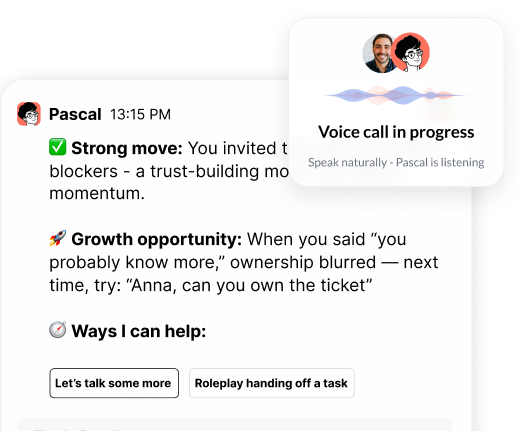
We built Pascal as that kind of companion. Pascal lives where managers already talk and work, and we designed it to provide calm, timely support at enterprise scale when leaders are under pressure.
In many companies, the default leadership development model looks like this:
When AI coaching serves as the backbone, the model shifts. Managers still get workshops and human coaches, but they also get help on Tuesday afternoon when a conflict blows up, or on Friday morning when they need to give sharp feedback and are not sure how to say it.
Take a VP of Engineering with 12 direct reports. In one week they might:
With Pascal in Slack, that VP can quickly ask:
We do not see AI coaching as a replacement for HR, mentors, or executive coaches. It keeps the learning alive between human touchpoints, and it surfaces where a human should step in, for example, when a pattern of risk, confusion, or repeated escalations appears. The backbone role is coordination and reinforcement, not substitution for human judgment or relationship.
For most managers, modern enterprise manager training software should feel less like a course site and more like a trusted colleague in their existing tools. For Pascal, that means:
A new manager about to run their first performance review cycle can ask Pascal for a plan. The AI can break it into steps: prepare notes linked to company values, structure each 1:1, set follow-ups, and phrase tricky points with care. Instead of a long article the manager has no time to read, they get a short, concrete playbook they can use that day.
A senior leader drafting a hard message about shifting priorities can paste a rough draft into Pascal. Pascal can help them:
In a large company, guardrails matter. We designed Pascal to stay within organizational rules by aligning with your values, leadership competencies, and HR policies. It can be tuned so that, for sensitive areas, it encourages the manager to involve HR or a people partner. We keep Pascal in the lane of work-related coaching, not therapy or personal counseling, and not as a substitute for human connection on sensitive issues.
AI coaching works best as part of a full leadership system, not on its own. Each component has a clear job.
Human-led elements do things AI should not try to do:
Workshops are well-suited for:
An AI coaching companion is strongest when it:
Consider a leadership program on “Leading Through Change.” People leave with good intent, then real life hits. Pascal can:
During a reorg, HR can look at aggregate, non-identifying insight from Pascal. For example, you might see many questions about explaining new role expectations or handling lower performance after changes. That can guide targeted support, like short clinics or updated manager guides.
We draw a clear line. Pascal is not therapy, does not replace trusted mentors or HR partners, and does not make final decisions for managers. It is a thinking partner that helps leaders stay grounded in your values while they move fast, and it complements, not replaces, human interaction and judgment.
If you are evaluating enterprise manager training software, it helps to have a clear checklist. Labels and demos can blur together, but certain capabilities matter at scale.
First, context-awareness. The AI should recognize whether it is helping with:
Second, guidance that drives behavior. In crunch time, managers do not want a ten-page article. They need:
Third, enterprise readiness. At a minimum, you should expect:
When you speak with vendors, useful questions include:
Measurement should stay grounded. Instead of unsourced ROI percentages, look at practical signals, such as:
Over time, these become visible health signs of your manager backbone.
End-of-year planning often means tight budgets and rising expectations. HR and L&D leaders are asked to raise manager performance without adding a heavy new program on top of everything else.
A practical way to test AI coaching as a training backbone is to run a focused, time-bound pilot:
That way, managers experience Pascal as part of how they already work and learn, not as one more tool to juggle. HR and business leaders can watch for simple signs: more prepared 1:1s, fewer confused messages during change, and more consistent conversations about goals.
We have seen global companies start by using Pascal to support managers through a new goal-setting approach. Once managers had a steady coaching companion for that one area, it became natural to expand into feedback, promotions, and change communication.
As you think about what will hold your manager growth together over the next few years, the core decision is straightforward: what do you want your backbone to be? We built Pascal so that your managers have a calm, always-on coaching companion, right inside the tools they already use, ready for the hard, specific moments leadership brings.
If you are ready to modernize how your organization develops leaders, we built our enterprise manager training software to make that transition simple and measurable. At Pinnacle AI, we combine AI-driven coaching with real-world management frameworks so your managers can apply what they learn immediately. Let us help you create a consistent, scalable development experience that supports every manager, at every level, in real time.



“Thank you for setting the great foundation for my promotion; now I have a plan!"

Curious to see how AI Coaching can 10X the impact and scale of your development initiatives. Book a demo today for: