

Organizations using AI coaching report that 83% of direct reports see measurable manager improvement. This strengthens leadership pipelines by accelerating development, improving succession readiness, and creating bench depth at scale.
Leadership pipeline strength measures an organization's ability to fill critical leadership roles with qualified internal candidates who can perform immediately. Strong pipelines demonstrate three characteristics: sufficient quantity of ready-now successors, quality of leadership capabilities across levels, and speed of development from identification to readiness.
The data reveals a crisis. Only 11% of companies report strong leadership bench strength, while 85% identify significant global pipeline gaps. Pipeline strength impacts business continuity, innovation capacity, and competitive advantage.
Traditional metrics like succession ratios and time-to-fill miss the quality dimension—whether promoted leaders actually perform. Modern pipeline assessment requires measuring manager effectiveness, not just headcount in development programs. The question isn't "How many people are in our leadership program?" but "What percentage of direct reports report manager improvement?"
Traditional vs. Outcome-Based Pipeline Metrics:
Data Breakdown:
• Traditional Metric: Number enrolled in leadership program | Outcome-Based Metric: % of direct reports reporting manager improvement
• Traditional Metric: Time-to-fill leadership roles | Outcome-Based Metric: Speed from identification to measurable performance
• Traditional Metric: Succession planning coverage ratio | Outcome-Based Metric: Ready-now successor quality (actual performance)
• Traditional Metric: Training hours completed | Outcome-Based Metric: Behavioral change in critical management moments
• Traditional Metric: Leadership program satisfaction scores | Outcome-Based Metric: Manager NPS and team engagement impact
AI coaching improves pipeline strength by making development continuous, contextual, and scalable. It addresses the gap between scheduled training events and daily leadership challenges. When managers receive guidance embedded in actual workflows (meetings, Slack, Teams), they develop faster and perform better immediately.
Traditional approaches like classroom training, annual reviews, and LMS courses provide information at the wrong time—disconnected from real decisions. A manager learns delegation frameworks in a workshop but faces a critical delegation decision three weeks later with no support. The learning doesn't stick because it's not applied in context.
AI coaching platforms deliver just-in-time support during actual management moments: difficult conversations, delegation decisions, feedback delivery. Continuous behavioral data shows what managers actually do, not what they remember from training. As Melinda Wolfe, former CHRO at Bloomberg, Pearson, and GLG, notes: "It makes it easier not to make mistakes. And it gives you frameworks to think through problems before you act."
Organizations with AI coaching adoption demonstrate quantifiable pipeline advantages. Managers save 150+ hours annually on development activities, and manager NPS increases by 20%. Companies without AI coaching continue reporting the same chronic gaps—insufficient bench depth and slow development cycles.
Traditional coaching reaches less than 5% of managers due to cost ($200-500 per hour). AI coaching reaches 100% of managers at a fraction of the cost. The economics change who gets access to development.
The leadership development market reached $6.25 billion in 2024 and is projected to hit $7.3 billion in 2025. This growth reflects recognition that pipeline strength impacts business performance.
Traditional Development vs. AI Coaching-Enabled Approach:
Data Breakdown:
• Dimension: Reach | Traditional Development: <5% of managers | AI Coaching-Enabled: 100% of managers
• Dimension: Cost per manager | Traditional Development: $200-500/hour | AI Coaching-Enabled: Significantly lower
• Dimension: Time to competency | Traditional Development: 12-18 months | AI Coaching-Enabled: 3-6 months
• Dimension: Adoption rate | Traditional Development: 15-30% (LMS platforms) | AI Coaching-Enabled: Higher (embedded tools)
• Dimension: Development timing | Traditional Development: Scheduled events | AI Coaching-Enabled: Real-time, in-workflow
Mid-market organizations face the "scaling gap"—too large for manual coaching of every manager, too small to justify enterprise LMS infrastructure that sits unused. AI coaching solves this by scaling leadership development without scaling headcount.
Companies with 200-4,000 employees typically have 20-400 managers—too many for traditional coaching, too few to justify complex learning platforms. Small HR teams (often 1 HR person per 100 employees) cannot provide individualized manager support at scale.
As one CHRO noted: "If we can democratize coaching—make it specific, timely, and integrated into real workflows—we solve one of the most chronic issues in the modern workplace." Mid-market tech, professional services, and life sciences companies see fast ROI because their managers face complex decisions daily but lack dedicated L&D support.
Integration with existing tools (Slack, Teams, Zoom) eliminates the adoption friction that kills enterprise platforms in mid-market environments.
Evaluate AI coaching platforms on five critical dimensions: whether coaching is proactive (provides real-time feedback) versus on-demand only, depth of organizational context (knowledge of past interactions versus generic responses), customization to company values and competencies, integration into daily tools, and data protection standards (SOC2 compliance, no training on customer data).
Most "AI coaching" is actually ChatGPT wrappers requiring managers to leave workflow and describe context manually—adoption fails within weeks. Purpose-built platforms are proactive (providing real-time guidance), perceptive (building knowledge of manager-team interactions), personalized (trained on company values and competencies), plugged-in (Slack, Teams, Zoom native), and protected (SOC2 compliant).
Ask vendors: "Does your platform know the context of my last three conversations with this team member, or do I have to explain it each time?" Platforms trained by ICF-certified coaches deliver different quality than generic LLMs.
Pipeline impact requires measuring behavior change (percentage of direct reports reporting improvement) not engagement metrics (logins, time spent). The difference between a chatbot and a coaching system is whether it changes manager behavior in critical moments.
AI Coaching Platform Evaluation Scorecard:
Data Breakdown:
• Platform Type: Generic Chatbot | Context Awareness: None (user explains each time) | Integration: Separate portal | Customization: Generic responses | Privacy: Trains on customer data | Measurable Outcomes: Engagement metrics only
• Platform Type: On-Demand Coach | Context Awareness: Session-based memory | Integration: Link from other tools | Customization: Limited to prompts | Privacy: Varies by vendor | Measurable Outcomes: Self-reported satisfaction
• Platform Type: Purpose-Built Proactive Coach | Context Awareness: Knowledge of interactions | Integration: Native in Slack/Teams/Zoom | Customization: Company values, competencies, frameworks | Privacy: SOC2, never trains on data | Measurable Outcomes: Direct report improvement rates
Organizations see initial adoption within 2-4 weeks and measurable behavior change within 90 days when AI coaching is embedded in existing workflows. Pipeline strength indicators—manager effectiveness scores, succession readiness, and bench depth—show improvement within 6 months. Traditional development programs require 12-18 months for similar outcomes.
The key differentiator is where coaching lives. Platforms requiring separate logins see 15-30% adoption. Tools embedded in Slack, Teams, and Zoom reach higher adoption because managers don't change behavior—they get support where they already work.
Early wins matter. When managers receive real-time feedback during actual meetings, they immediately apply guidance. One engineering manager reported: "It helped me navigate a difficult performance conversation I was dreading. It gave me frameworks to think through the problem before I acted."
Organizations should expect three phases: rapid adoption (weeks 1-4), behavior change (months 2-3), and pipeline impact (months 4-6). The compressed timeline compared to traditional development reflects the power of continuous, contextual coaching versus scheduled training events.
Measure AI coaching ROI through three lenses: manager effectiveness (direct report improvement rates, manager NPS, team engagement), time savings (hours saved on development activities, faster ramp time for new managers), and pipeline strength (succession readiness, internal promotion rates, bench depth quality).
Traditional L&D ROI struggles because it measures inputs (training hours, completion rates) not outcomes (behavior change, performance improvement). AI coaching platforms surface behavioral data showing what managers actually do in critical moments.
CFOs understand ROI when it's quantified: If traditional coaching costs $300/hour and reaches 5% of managers, while AI coaching costs significantly less and reaches 100%, the math is clear. Add measurable improvements in manager effectiveness and the business case strengthens.
The leadership development market's growth—from $6.25 billion in 2024 to projected $7.3 billion in 2025—reflects organizations recognizing that pipeline strength drives competitive advantage. Companies that democratize coaching through AI see faster development, better succession readiness, and stronger bench depth than those limiting coaching to executives.
• Pipeline strength requires manager quality, not just quantity: Only 11% of companies report strong bench strength, while 85% identify critical gaps—AI coaching addresses the quality dimension traditional metrics miss
• AI coaching delivers measurable outcomes at scale: Direct report improvement rates, higher adoption, 150+ hours saved per manager annually, and 20% manager NPS increases demonstrate quantifiable pipeline impact
• Mid-market organizations see strong ROI: Companies with 200-4,000 employees face the scaling gap—too large for manual coaching, too small for enterprise LMS—making AI coaching a strong solution
• Platform selection determines success: Purpose-built proactive coaches (embedded in Slack/Teams/Zoom with organizational context) drive higher adoption versus separate portals
• Implementation timelines compress: Organizations see adoption in 2-4 weeks, behavior change in 90 days, and pipeline impact in 6 months versus 12-18 months for traditional programs
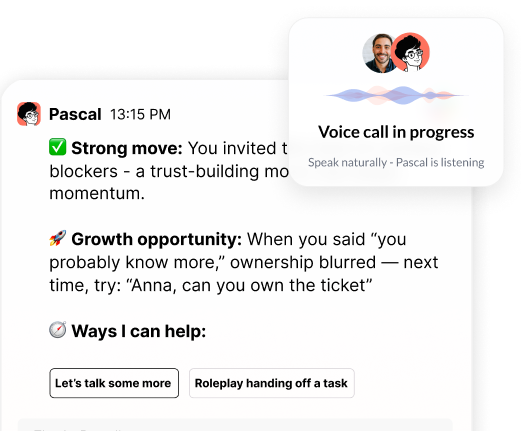
See how Pascal works inside Slack, Teams, and Zoom to strengthen your leadership pipeline at heypinnacle.com.
Header photo by Resume Genius on Unsplash

.png)
.webp)
“Thank you for setting the great foundation for my promotion; now I have a plan!"

Curious to see how AI Coaching can 10X the impact and scale of your development initiatives. Book a demo today for: