

A technology company defined "strategic thinking" as "making build-versus-buy decisions that balance technical debt against feature velocity." When their engineering managers asked a generic AI chatbot for strategic advice, they got frameworks about market positioning and competitive analysis—textbook answers that had nothing to do with the technical tradeoffs they faced daily. The managers stopped using the tool within two weeks.
AI coaching personalization means embedding your organization's leadership definitions, competency frameworks, and cultural values directly into the coaching system. Instead of generic advice, managers get guidance that uses your language, reinforces your expectations, and references your internal materials.
AI coaching is a conversational platform (typically a chatbot interface) that provides management guidance on demand. A manager types a question like "How do I give feedback to an underperforming team member?" and receives specific advice within seconds.
The platform can work three ways: as a standalone chat interface managers access when they need help, as a meeting observer that analyzes conversation patterns and sends feedback afterward (with explicit consent from all participants), or as an integrated system that pulls data from your HRIS and performance management tools to personalize responses.
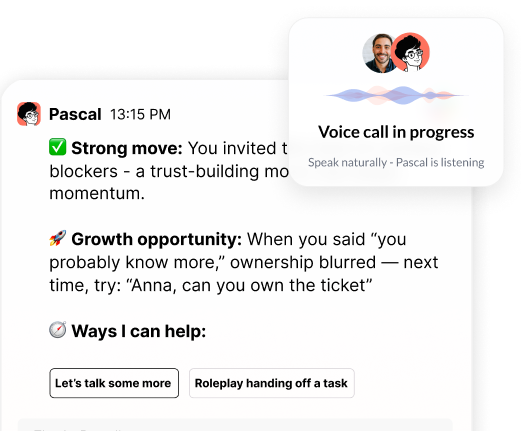
Here's what a conversation looks like. A manager asks: "My team member missed three deadlines this month. How do I address this?" A generic AI responds with textbook feedback frameworks. A personalized AI responds: "Based on your company's accountability competency, this situation requires a direct conversation within 24 hours. Use the SBI model from your manager training: describe the Situation (three missed deadlines in March), the Behavior (what specifically happened), and the Impact (how this affected the team's sprint goals). Reference the performance improvement process in your handbook if the pattern continues."
The difference is specificity. Personalized AI coaching knows your frameworks, your processes, and your language.
Your competency model defines what "strategic thinking," "people development," or "execution excellence" mean in your organization. A financial services company might define accountability as "escalating client issues within four hours." A software company might define it as "owning technical decisions even when they slow down shipping." These aren't interchangeable.
Generic AI tools trained on broad leadership principles can't distinguish between your definition and another company's. When managers receive coaching that introduces external frameworks, you create confusion. Your training programs teach one approach. Your performance reviews measure another. Your AI coach suggests a third.
At Pinnacle, we've seen this pattern repeatedly: companies adopt generic AI tools, managers get advice that contradicts internal training, and usage drops to zero within a month.
Data Breakdown:
• Factor: Cost | Traditional Coaching: $3,000–$15,000 per person annually | Generic AI Tools: Free to $20/month per user | Personalized AI Coaching: $50–$150 per user annually
• Factor: Accessibility | Traditional Coaching: 5–10% of managers (senior leaders only) | Generic AI Tools: 100% of managers | Personalized AI Coaching: 100% of managers
• Factor: Timing | Traditional Coaching: Scheduled quarterly | Generic AI Tools: Available on demand | Personalized AI Coaching: Available on demand
• Factor: Customization | Traditional Coaching: Vendor frameworks | Generic AI Tools: Generic leadership principles | Personalized AI Coaching: Your frameworks, language, and values
• Factor: Context | Traditional Coaching: Coach learns over 6–12 months | Generic AI Tools: No organizational context | Personalized AI Coaching: Embedded with your competencies and performance data
The critical difference is customization. Traditional coaching and generic AI both use external frameworks. Personalized AI uses your frameworks, embedded as the foundation of every response.
A competency framework defines the skills and behaviors your organization values, broken down by role and level. It answers: What does "strategic thinking" look like for an individual contributor versus a director?
Upload your complete framework with specific definitions and behavioral indicators for each level. If your sales leaders need different capabilities than your engineering managers, tag frameworks by function.
For example, your framework might define "people development" for a first-time manager as "conducting weekly 1:1s and documenting development goals" and for a director as "building succession plans and sponsoring high-potential employees for stretch assignments." The AI needs both definitions to give relevant advice based on who's asking.
The platform uses your competency model as its primary reference. When a manager asks about developing their team, the system quotes your organization's definition of "people development" and points to your internal training materials.
You'll know this works when managers start using your competency language in their daily conversations. If your framework calls it "strategic thinking" and managers start saying "I'm working on my strategic thinking skills" instead of "I'm trying to be more strategic," the AI is reinforcing your terminology.
Personalization requires two layers: organizational context (your values and competencies) and individual context (each manager's development needs, performance history, and role).
Connect your HRIS and performance management systems. Relevant data includes performance review ratings, 360 feedback themes, engagement survey responses, development plans, and role-specific goals.
A manager rated "needs improvement" on "difficult conversations" should receive proactive guidance when their calendar shows a performance discussion scheduled. A manager with high scores on "strategic thinking" but low scores on "execution" should get different coaching than someone with the opposite pattern.
Individual data should be used only for that person's coaching. Aggregated insights go to HR leaders (for example, "40% of engineering managers are asking about retention conversations" signals a trend worth addressing). This protects privacy while giving HR visibility.
At one client (a 300-person SaaS company), managers used a generic AI tool 0.8 times per month on average. After implementing personalized coaching with integrated performance data, usage jumped to 4.2 times per week. The difference was relevance.
Your training decks, culture handbooks, and leadership guides represent years of organizational wisdom. AI coaching platforms can ingest these materials and reference them during conversations.
Provide new manager training content, leadership development materials, culture documentation, values guides, communication frameworks, and escalation procedures.
When a manager asks about giving difficult feedback, the AI references your specific model—whether that's SBI (Situation-Behavior-Impact), COIN (Context-Observation-Impact-Next steps), or a custom framework you built. It doesn't introduce a different approach from a generic leadership book.
Tag content by department and level. Your sales team's objection-handling guide isn't relevant to engineering managers. Your director-level strategic planning materials don't help first-time managers running their first 1:1.
One financial services client uploaded 47 internal documents (everything from their new manager bootcamp to their crisis communication playbook). The AI now references these materials in 73% of coaching conversations, ensuring managers get advice consistent with what they learned in training.
The most sophisticated AI coaching platforms observe work patterns and provide proactive guidance. The system notices a manager interrupts team members frequently in meetings and sends feedback referencing your company's "inclusive leadership" definition. It sees someone avoiding difficult conversations and provides guidance using your escalation procedures.
This is workplace surveillance. You need to address it head-on.
Any system that observes meetings requires explicit opt-in from all participants before every meeting. Not a blanket consent form signed during onboarding—active consent each time. The AI should analyze patterns (like speaking time distribution or question-asking frequency) but never record or store meeting content. Transcripts and recordings create legal liability and destroy trust.
You need clear policies about what gets observed, how data is used, and who has access. Managers should see only their own feedback. HR leaders should see only aggregated trends with no individual identifiers. No data should be used in performance reviews without the manager's explicit permission.
Some companies will decide this tradeoff isn't worth it. If your culture values privacy over optimization, don't implement meeting observation. Stick with on-demand coaching where managers ask questions voluntarily.
If you do implement proactive coaching, acknowledge the creepiness factor. In your rollout communication, say explicitly: "This system observes meeting patterns to help you improve. We know this feels invasive. Here's exactly what we track, here's what we don't track, and here's how we protect your data." Transparency builds trust. Vague reassurances destroy it.
The legal risks are real. In California, recording conversations without all-party consent violates the law. In the EU, GDPR requires data minimization and purpose limitation. Consult employment lawyers in every jurisdiction where you operate before implementing meeting observation.
If "inclusive leadership" is a focus area, configure the system to observe meeting dynamics (speaking time distribution, interruption patterns, question-asking frequency) and provide feedback referencing your specific definition of inclusion. If "strategic thinking" matters most, configure guidance around goal-setting, prioritization, and long-term planning.
The platform should retain context across conversations. If a manager asks about a difficult team member on Monday and follows up on Friday, the AI should remember the situation and build on the previous advice. This requires storing conversation history (with the manager's knowledge and consent).
Context retention creates better coaching over time. The system learns each manager's relationships, challenges, and development priorities. After three months, the guidance becomes increasingly relevant because the AI knows what this specific manager is working on.
Track whether managers use your competency language in development conversations. When AI coaching successfully embeds your frameworks, managers naturally reference your definitions, your feedback models, and your cultural values in their daily work.
At a 500-person healthcare company, we measured this by analyzing performance review comments before and after implementing personalized AI coaching. Before: 12% of reviews referenced the company's competency framework. After six months: 64% of reviews used framework language. Managers were internalizing the company's definitions of success.
Second-order metrics include manager effectiveness scores from direct reports, engagement survey results, and retention rates among high performers. These lag by 6–12 months, so don't expect immediate movement.
Examine the AI's escalation patterns. Purpose-built systems include guardrails that recognize when situations require human HR intervention (harassment allegations, mental health crises, legal violations). The system should flag these immediately and route them to appropriate people. If your AI is coaching managers through situations that require HR or legal involvement, you have a serious problem.
Anonymous aggregated insights reveal organizational trends. What challenges are managers facing most frequently? Which competencies show the widest gaps between current and desired performance? At one client, aggregated data showed 60% of managers were asking about retention conversations—a signal that compensation or culture issues needed attention.
Start with your competency framework documentation. Provide complete definitions with behavioral indicators for each level and examples of what proficiency looks like in practice. If frameworks vary across functions, tag them by department.
Integrate performance data sources. Connect your HRIS, performance management system, and engagement survey platform. Map data fields carefully (your "performance rating" field might be called "overall score" in another system). Ensure individual data flows only to that person's coaching while aggregated insights go to HR.
Upload your training materials, culture documentation, and leadership guides. Tag content by department and level. Specify which materials apply company-wide versus team-specific.
Configure proactive coaching triggers aligned with your priorities. Test with a pilot group (20–30 managers across different functions and levels) before full deployment. Gather feedback on whether the coaching reflects your organization's language, values, and expectations.
Budget 3–6 months for enterprise software integration. HRIS connections require API access, data mapping, security reviews, and testing. The technical work matters less than the strategic work of documenting your frameworks clearly. If your competency model is vague or inconsistent, the AI will amplify that vagueness.
One critical question the diagnostic report raised: What if your competency model is bad? What if your values are toxic? Personalized AI coaching amplifies whatever exists. If your framework defines "accountability" as "never admitting mistakes" or "strategic thinking" as "always agreeing with the CEO," the AI will reinforce those dysfunctions. Fix your frameworks before you embed them in technology.
• AI coaching is a conversational platform (chatbot, meeting observer, or integrated system) that provides management guidance on demand, personalized to your organization's frameworks and each manager's context.
• Generic AI tools fail because they can't distinguish between your definition of competencies and another company's, creating confusion when advice contradicts your internal training.
• Personalization requires uploading your competency frameworks with specific behavioral indicators, integrating performance data from your HRIS, and training the AI on your internal materials.
• Proactive coaching that observes meetings is workplace surveillance and requires explicit consent, clear policies about data use, and legal review in every jurisdiction where you operate.
• Measure success by tracking whether managers use your competency language in daily work, examining second-order metrics like engagement and retention, and reviewing aggregated insights about organizational trends.
The gap between generic AI tools and personalized coaching comes down to whether the system knows your organization. Generic chatbots provide the lowest common denominator of advice. Purpose-built platforms (like Pinnacle) embed your frameworks, integrate your data, and reinforce your culture in every interaction.
Header photo by Vitaly Gariev on Unsplash

.png)
.webp)
“Thank you for setting the great foundation for my promotion; now I have a plan!"

Curious to see how AI Coaching can 10X the impact and scale of your development initiatives. Book a demo today for: