
An AI coach needs enough context to personalize guidance and earn trust, but not so much that it creates privacy risk or amplifies bias. The answer lies in a "minimum viable context" model: role, goals, performance signals, and interaction history are usually sufficient; deeper personal data should remain opt-in, transparent, and tightly governed.
Quick Takeaway: Purpose-built AI coaches deliver better outcomes when they access behavioral and role-specific data rather than deep personal information. Recent research shows that neutral signals—engagement trends, participation patterns, and expressed interests—guide recommendations more effectively than subjective manager opinions or demographic details. The most effective platforms balance contextual depth with strict privacy safeguards and clear escalation protocols for sensitive topics.
The tension between personalization and privacy defines AI coaching in 2025. Organizations want coaching that feels custom rather than templated. Employees want support that understands their challenges without surveillance. The answer isn't maximizing data access. It's being intentional about which data actually improves coaching quality, and how to protect it.
Purpose-built AI coaches deliver better outcomes when they access behavioral and role-specific data rather than deep personal information. Recent research shows that neutral signals guide recommendations more effectively than subjective manager opinions or demographic details.
CoachHub's AIMY™ platform explicitly avoids relying on "managerial recommendations or subjective reviews," instead using "neutral behavioral data—such as an employee's engagement trends, participation in development programs, and expressed learning interests". This distinction matters enormously. Behavioral data—what people actually do and choose—predicts coaching effectiveness better than subjective assessments or personal background.
High-value context includes role and level, stated career goals, skills gaps, performance trends (not narrative reviews), and coaching interaction history. Interaction preferences matter equally: coaching style, language, voice preference, and previous response to guidance help tailor delivery without requiring personal backstory. When managers don't need to repeatedly explain situations, friction disappears and adoption becomes natural.
ChatGPT and similar tools provide one-size-fits-all advice because they lack knowledge of your culture, your people's specific relationships, and your company's leadership expectations. Managers quickly abandon tools that require repeatedly explaining situations or don't reflect how your organization actually operates.
Generic AI coaches can't reference your company's values, competency frameworks, or culture documentation, forcing managers to mentally translate generic advice into their context. Without integration into your HRIS or performance systems, AI coaching remains disconnected from real employee data, reducing relevance and adoption. Organizations using context-aware platforms report 94% monthly retention with an average of 2.3 coaching sessions per week, far exceeding typical digital learning completion rates.
Purpose-built AI coaches should integrate with HRIS, performance management systems, and communication platforms to understand team structure, career aspirations, and actual work patterns—but only with transparent consent and clear boundaries.
Role and career data including job family, level, stated goals, skills assessments, and promotion timeline enable targeted development planning. Performance signals like recent review themes, 360 feedback patterns, and goal progress personalize coaching without creating surveillance concerns. Team dynamics visible through meeting participation, collaboration patterns, and communication frequency help identify coaching moments and team health signals. Company context including values, competency frameworks, culture documentation, and leadership expectations ensure coaching aligns with how success is defined in your environment.
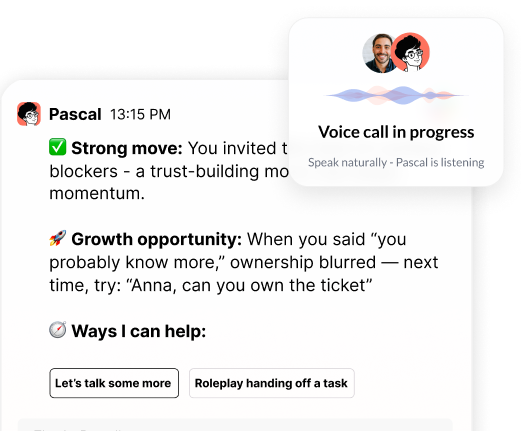
Interaction history—past coaching topics, coaching style preferences, and response patterns—improves relevance and builds continuity. Pascal integrates all these layers by connecting with your HRIS, observing meeting dynamics through Zoom and Google Meet integration, and learning your company's specific values and frameworks. The result is coaching that feels custom because it actually is.
AI coaches should recognize and escalate situations involving sensitive employee topics, emotional distress, legal risk, or ethical complexity—not because they lack data, but because human judgment is irreplaceable in these moments.
The International Coaching Federation's 2024 ethics update requires AI tools to be "aligned with coaching values of trust, confidentiality, and professional responsibility" and states that "AI should be applied to facilitate insights, not make independent decisions about clients". If an AI coach detects serious emotional issues like burnout or distress, it should flag a human mentor or HR rather than attempting to handle deeply personal matters alone. Sensitive topics requiring escalation include terminations, harassment concerns, medical accommodations, mental health crises, and major career transitions.
Key Insight: The most sophisticated AI coaches include moderation and escalation protocols that recognize when situations require human expertise. The AI should flag—not attempt to handle—terminations, harassment, mental health concerns, and other sensitive topics. This protects both your organization and your people while building trust in the system.
Effective AI coaching platforms maximize transparency about data access, give employees control over their information, and never use customer data for AI model training. This builds trust while delivering personalization.
Data should be stored at the user level, making cross-account leakage technically impossible. Employees should be able to view and edit what the AI knows about them through transparent settings. Regulatory compliance with GDPR and CCPA should be standard, not premium features. Clear communication about what data informs coaching, why it's needed, and who can access it removes a significant adoption barrier.
Pascal maintains SOC2 compliance and never trains AI models on customer data. All employee conversations remain confidential. Data is encrypted with enterprise-grade protection, and users can review and adjust their profile information at any time. This transparency builds the trust that makes people willing to engage authentically with AI coaching.
The emerging standard combines AI for scalable, data-driven guidance with human coaches for complex, emotionally charged, or ethically nuanced situations. This blended approach delivers both scale and depth.
AI handles feedback preparation, delegation coaching, goal-setting, and team dynamics guidance. Human coaches provide strategic career counsel, high-stakes conflict resolution, and cultural transformation guidance. Organizations see this hybrid model as the future because it extends development access while preserving human expertise where it matters most.
| Coaching Need | AI Coach Role | Human Coach Role |
|---|---|---|
| Feedback preparation | Full support with roleplay and talking points | Strategic guidance for complex situations |
| Delegation coaching | Framework and real-time guidance | Deep relationship and culture navigation |
| Team conflict | Facilitation approaches and talking points | High-stakes mediation and resolution |
| Performance issues | Conversation structure and documentation | Legal and HR compliance guidance |
Moving from vendor selection to sustained impact requires thoughtful attention to change management, integration, and measurement. The most successful implementations combine clear communication about data use, executive sponsorship, and metrics that track both adoption and outcomes.
Organizations should communicate transparently about what data the platform accesses and why that data improves coaching. Employees need reassurance that 71% of employees express concern about company adoption of AI, making trust-building essential. Companies like HubSpot, Zapier, and Marriott succeeded by embedding AI into existing workflows and making clear that the technology augments rather than replaces human judgment.
Measurement should track leading indicators like session frequency and behavioral change alongside lagging indicators like team engagement and retention. 83% of direct reports report measurable improvement in their managers when using context-aware AI coaching, with an average 20% lift in Manager Net Promoter Score among highly engaged users. These outcomes flow directly from coaching that's relevant enough to be applied immediately.
"AIMY™ doesn't rely on managerial recommendations or subjective reviews. Instead, it uses neutral behavioral data—such as an employee's engagement trends, participation in development programs, and expressed learning interests—to guide its coaching recommendations."
The organizations winning with AI coaching in 2025 are those treating vendor selection as a strategic decision, not a procurement exercise. They're evaluating not just features but foundations: Does the platform demonstrate genuine coaching expertise grounded in people science? Does it integrate deeply enough with your systems and workflows to maintain rich context? Can it proactively surface opportunities rather than waiting to be asked? Does it handle sensitive topics appropriately?
These questions separate transformative AI coaching implementations from expensive experiments that fail to drive adoption or behavior change. The sophistication level you choose directly impacts outcomes: manager effectiveness, team performance, retention, and the strategic capacity of your HR team.
The difference between generic AI and purpose-built coaching comes down to context. Pascal integrates with your HRIS and communication tools to deliver personalized guidance grounded in actual employee data, team dynamics, and your company's culture—while maintaining strict privacy protections and appropriate escalation for sensitive topics. See how Pascal provides the right amount of context to drive manager effectiveness without creating privacy or bias risk. Book a demo to explore how contextual awareness transforms coaching from generic advice into actionable, trusted support.

.png)
.webp)
“Thank you for setting the great foundation for my promotion; now I have a plan!"

Curious to see how AI Coaching can 10X the impact and scale of your development initiatives. Book a demo today for: