
Effective AI coaches need task-level and goal-level context plus limited, well-governed work data—not full biographical profiles. The right amount of context eliminates friction while enabling personalized guidance grounded in your organization's reality, without creating privacy or compliance risk.
Quick Takeaway: AI coaches that know nothing about your people deliver generic advice. AI coaches that know everything create privacy nightmares. The question for CHROs isn't whether context matters—it's how much context actually drives better coaching outcomes, and what data governance makes that safe.
The tension between personalization and privacy defines the current AI coaching landscape. Organizations want coaching that feels custom rather than templated. Employees want support that understands their challenges without surveillance. The answer lies not in maximizing data access, but in being intentional about which data actually improves coaching quality—and how to protect it.
Effective AI coaches need task-level and goal-level context plus limited, well-governed work data—not full biographical profiles. Performance reviews, career goals, and role information shape coaching relevance without requiring personal details. Communication patterns and team dynamics enable real-time feedback tied to actual work moments. Company values, competency frameworks, and culture documentation ensure coaching aligns with how success looks in your environment.
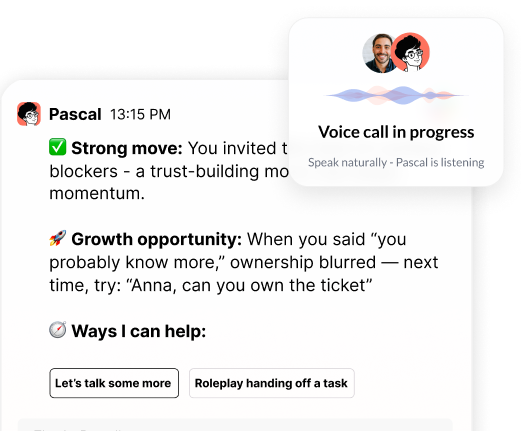
When managers don't need to repeatedly explain situations, friction disappears and adoption becomes natural. The difference between generic AI and purpose-built coaching comes down to context. Pascal integrates with performance management systems, career development data, and meeting transcripts without requiring manual data uploads or separate logins. Data is stored at the user level, preventing information from leaking across accounts. This approach delivers personalization while respecting boundaries.
ChatGPT and similar tools provide lowest-common-denominator advice because they lack knowledge of your people, culture, and actual work patterns. Managers quickly abandon generic guidance that doesn't reflect their specific situations. 51% of employees prefer a mix of AI and human coaching, not AI alone, according to recent workplace research, signaling that AI must prove its value through contextual relevance.
Generic tools require managers to repeatedly explain team dynamics, performance history, and organizational norms before receiving any useful guidance. Without context, coaching can't address the nuance that determines success: this manager's communication style with this employee on this project in your specific culture. Organizations see adoption collapse when guidance doesn't account for organizational realities, forcing managers to mentally translate generic advice into their context.
Recent research shows that companies linking AI into platforms employees already use to gather contextual data see dramatically higher engagement, with Accenture reducing managers' time spent on evaluations by 60% through AI support while freeing time for higher-value coaching conversations.
Personal health information, family details, and sensitive demographic data create compliance risk without improving coaching quality. Purpose-built platforms practice data minimization: accessing only work-related context necessary to deliver useful guidance. The International Coaching Federation's 2024 ethics update explicitly requires AI coaches to maintain confidentiality, disclose their use, and align with core coaching values—which means limiting data access to what's professionally necessary.
Extra demographic or sensitive data can increase algorithmic bias without improving guidance quality. Employees need transparency about what data the AI accesses and explicit control over their information. Effective platforms isolate coaching conversations at the user level, making cross-employee data leakage technically impossible.
Key Insight: Data minimization isn't about limiting coaching effectiveness. It's about using only the data that actually improves guidance while protecting privacy and reducing bias risk.
Link the AI into platforms employees already use (HRIS, Slack, Teams, LMS) to gather contextual data, then enforce strict privacy controls, user-level data isolation, and transparent governance. This approach delivers personalization while respecting boundaries. Companies should link AI into platforms employees already use to gather contextual data, and ensure privacy and security on that data pipeline according to recent team-development research.
Pascal integrates with performance management systems, career development data, and meeting transcripts without requiring manual data uploads or separate logins. Data is stored at the user level, preventing information from leaking across accounts. Never use customer data for AI model training; this protects confidentiality and prevents your organizational insights from improving competitors' systems.
| Data Source | Coaching Value | Privacy Considerations |
|---|---|---|
| Performance reviews and goals | Personalizes feedback and development planning | Moderate risk, requires access controls |
| Team structure and role information | Enables team dynamics awareness | Low risk, generally non-sensitive |
| Company values and competencies | Aligns coaching with organizational culture | Low risk, typically public internally |
| Meeting transcripts and communication patterns | Identifies coaching moments and behavioral patterns | Moderate risk, requires transparency |
Sophisticated AI coaches include moderation and escalation protocols that recognize when situations require human expertise. The AI should flag—not attempt to handle—terminations, harassment, mental health concerns, and other sensitive topics. If an AI coach detects serious emotional issues like burnout or distress, it should flag a human mentor or HR rather than attempting to coach through deeply personal matters.
Platforms without proper boundaries introduce legal risk when they provide guidance on terminations, discrimination claims, or employee grievances. Customizable guardrails let you define which topics trigger escalation based on your organization's risk tolerance and HR team capacity. Effective platforms provide transparency to employees about what triggers escalation, building trust rather than creating surveillance concerns.
Organizations using contextual AI coaching report higher adoption, faster skill development, and measurable improvements in manager effectiveness because relevance drives engagement. Generic AI coaching, lacking context, sees adoption decline after initial curiosity. Contextual platforms maintain 94% monthly retention with an average of 2.3 coaching sessions per week, far exceeding typical digital learning completion rates.
83% of colleagues see measurable improvement in their managers when using contextual AI coaching, with an average 20% lift in Manager Net Promoter Score. When coaching integrates with daily workflows and understands organizational context, friction disappears and adoption becomes natural rather than forced. The business case becomes clearer: at 1/20th to 1/100th the cost of human coaching, contextual AI extends development access to every manager rather than just executives.
Ask specific questions about what data the platform accesses, how it protects privacy, and how it uses organizational context to personalize guidance. Vague answers about "integrations" often mask limited contextual capability. What systems does the platform connect to? Does it access HRIS, performance data, communication patterns, and company documentation—or just conversation history?
How does the platform handle data isolation and prevent cross-user leakage? Can you customize the AI with your company's values and competency frameworks to ensure coaching aligns with your culture? What escalation protocols exist for sensitive topics, and can you configure which topics trigger human involvement? Does the platform provide aggregated, anonymized insights to HR teams about skill gaps and development patterns? Three veteran CHROs recently joined Pinnacle as strategic advisors specifically because they recognized that purpose-built platforms with proper context, guardrails, and organizational alignment deliver measurably better outcomes than generic tools.
"Companies should link the AI into platforms employees already use to gather contextual data, and ensure privacy and security on that data pipeline."
The difference between generic AI and purpose-built coaching comes down to context. Pascal integrates with your HRIS, performance systems, and communication tools to understand your people and culture—then delivers personalized guidance in Slack, Teams, or Zoom without requiring managers to explain situations repeatedly. With customizable guardrails, user-level data isolation, and proper escalation for sensitive topics, Pascal gives you the context advantage without the compliance risk. Book a demo to see how Pascal delivers coaching that actually fits your organization and drives measurable improvements in manager effectiveness.

.png)
.webp)
“Thank you for setting the great foundation for my promotion; now I have a plan!"

Curious to see how AI Coaching can 10X the impact and scale of your development initiatives. Book a demo today for: