

Which employee populations and roles unlock the fastest measurable ROI from AI coaching, and what specific outcomes should organizations expect within defined timeframes? New managers, sales professionals, and engineering leaders at growth-stage companies benefit most because their work involves frequent, high-stakes decisions where real-time feedback drives immediate measurable outcomes. These populations show 40% faster skill development and ROI within 60–90 days, making them ideal first users for proving AI coaching value and building internal momentum.
Quick Takeaway: Start with new managers, sales professionals, and distributed teams—populations where AI coaching solves immediate, measurable business problems within weeks. Success with these high-ROI groups builds credibility that accelerates broader adoption faster than universal rollouts. Organizations that prioritize strategic populations over organizational convenience achieve 80%+ adoption within the first month.
New managers, sales professionals, and engineering leaders at scaling companies benefit most because their work involves frequent, high-stakes decisions where real-time feedback compounds advantage quickly. These populations face the steepest learning curves, receive the least consistent support, and generate immediate business impact when coached effectively. First-time managers navigate situations they've never encountered—their first performance review, their first difficult feedback conversation, their first team conflict. Sales professionals work in high-velocity environments where conversion rates and pipeline velocity provide immediate measurement. Engineering managers at rapid-growth companies juggle hiring, cultural preservation, and team scaling challenges simultaneously. Distributed and remote teams lack geographic access to human coaching and benefit from equitable, always-on support. Individual contributors transitioning to management need rapid skill development without disrupting technical contributions.
Traditional training fails these populations because it targets the 10% of learning that happens formally, rather than the 70% that occurs on the job. Managers rarely need help in a workshop. They need it when preparing for a tough 1:1 or in the middle of team conflict. When those moments go wrong, the costs ripple: broken trust, bad decisions, legal exposure, or disengaged teams.
New managers need coaching most urgently, receive it least consistently, and generate immediate business impact when supported—making them ideal for proving AI coaching ROI and building internal momentum. 60% of new managers receive zero formal training before stepping into their role, yet 70% of team engagement variance comes down to manager effectiveness. This gap creates both crisis and opportunity. When new managers receive consistent AI coaching on foundational skills, the improvements compound quickly into visible team performance gains.
Measurable improvement appears within 30 days when managers receive consistent AI coaching on delegation, feedback, and one-on-one effectiveness. New managers reach performance milestones 40% faster with AI coaching compared to traditional training alone. 83% of direct reports see measurable improvement in their manager's effectiveness after sustained AI coaching engagement. Early wins in this visible population create peer advocacy that accelerates broader adoption faster than universal rollouts.
AI coaching accelerates their effectiveness by providing just-in-time guidance exactly when they need it, eliminating the gap between learning and application that traditional training can't bridge. When a new manager completes their first difficult performance conversation, they receive immediate feedback on what worked and what to adjust next time—while the context is still fresh and the opportunity to apply learning still exists.
Sales managers, engineering managers at growth-stage companies, and first-time managers in technical roles show the fastest improvement because their work involves frequent, repeatable decisions where AI pattern recognition drives immediate performance gains. Sales professionals using AI coaching achieved 19.7% higher conversion rates compared to traditional manager coaching alone. Results become visible within 7–14 days in sales environments due to rapid decision cycles and measurable metrics. Engineering managers benefit from AI coaching on delegation, code review feedback, and technical performance conversations within 30–45 days. High-growth companies (Series A–C) see faster ROI because managers juggle rapid scaling and frequent hiring decisions where consistent guidance creates immediate advantage. Remote-first and distributed teams show adoption rates 3x higher than co-located teams because AI removes scheduling friction and geographic constraints.
| Population | Time to Measurable Impact | Key ROI Metric | Adoption Rate |
|---|---|---|---|
| New managers | 30–60 days | Manager NPS, direct report engagement | 85%+ |
| Sales professionals | 7–14 days | Conversion rates, pipeline velocity | 90%+ |
| Engineering managers | 30–45 days | Team productivity, delegation quality | 80%+ |
| Distributed teams | 14–30 days | Adoption rate, engagement consistency | 3x co-located |
Fast-paced, data-driven industries see stronger ROI from AI coaching than slower-moving sectors because real-time feedback compounds advantage in high-frequency decision environments. E-commerce organizations report 18.8% performance improvement from AI coaching due to rapid decision cycles and measurable metrics. Organizations with strong learning cultures see 4x higher adoption rates because managers already expect continuous development support. Companies with high manager turnover see disproportionate benefit because AI coaching accelerates new manager ramp time and reduces costly onboarding mistakes. Culture and leadership maturity determine whether AI coaching becomes a daily habit or remains underutilized.
"When it comes to helping first-time or mid-level managers, the risk of doing nothing can be just as high as the risk of trying something new."
Organizations like HubSpot and Zapier are demonstrating what becomes possible when AI coaching is designed specifically for manager development. HubSpot's approach of integrating AI into daily workflows created an "all boats rise" effect where adoption became natural rather than forced. Zapier's focus on embedding AI fluency into hiring and performance reviews showed that cultural readiness matters as much as technology capability.
After proving ROI with your first population (typically 60–90 days), expand to adjacent populations that share similar characteristics: frequent decisions, measurable outcomes, or geographic distribution challenges. Tier 1 (highest ROI) includes new managers in sales, engineering, and customer-facing roles. Tier 2 (strong ROI) includes mid-level managers managing managers, technical individual contributors in first management role, and distributed team leads. Tier 3 (moderate ROI) targets high-performers seeking blind-spot identification and managers in slower-paced industries. Tier 4 (lowest ROI) represents C-suite requiring human coaches, highly specialized roles, and situations requiring deep psychological safety work.
Organizations that expand based on proven ROI rather than organizational convenience build sustainable momentum that lasts beyond initial enthusiasm. As Jeff Diana, former CHRO at SuccessFactors and Calendly, explains, successful AI adoption starts with tasks, not tools. Identify the specific coaching moments where AI adds value, then expand systematically based on demonstrated results.
Key Insight: The expansion strategy matters as much as initial selection. Organizations that move quickly with mature platforms see 80%+ adoption within the first month, compared to single-digit adoption rates for those running six-month pilots with limited functionality.
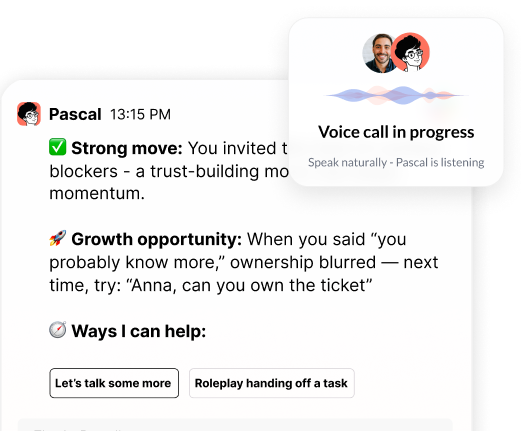
Pascal delivers immediate value through contextual awareness that eliminates setup friction, proactive engagement that surfaces coaching at natural moments, and workflow integration that makes coaching a daily habit. Contextual awareness pulls performance data, career goals, and team dynamics so new managers receive personalized guidance for specific situations rather than generic frameworks. Proactive engagement joins meetings and surfaces feedback within hours, creating consistent development habits that drive behavior change faster than reactive tools. Workflow integration in Slack and Teams means managers access coaching without context-switching, driving 94% monthly retention and 2.3 sessions per week among engaged users.
Guardrails and escalation protocols ensure sensitive topics get appropriate human involvement while protecting your organization from AI misuse. When a manager's conversation touches on potential harassment, medical issues, or termination decisions, Pascal escalates to HR while helping the manager prepare for that conversation appropriately. This approach de-risks AI adoption by ensuring appropriate human expertise gets involved when it matters most.
The technical setup for Pascal takes days, not months. Organizations install the Slack or Teams app, share relevant company documentation like values and competency frameworks, and identify initial users. The harder work is change management. Three veteran CHROs recently joined Pinnacle as strategic advisors, bringing decades of experience scaling people programs. Their consistent insight: organizations that build clear business cases, pilot with intention, and measure rigorously see adoption and impact exceeding expectations.
Track leading indicators like weekly active users and coaching sessions per manager to show adoption trends before behavioral outcomes become visible. Lagging indicators like manager effectiveness scores and direct report engagement prove ROI but take quarters to materialize. Measure both simultaneously, celebrating leading indicators early to maintain momentum during the lag period. Organizations using Pascal report that 83% of direct reports see measurable improvement in their manager, with an average 20% lift in Manager Net Promoter Score among highly engaged users. One tech company with 50 employees estimated saving 150 hours of management time in their initial rollout.
The most compelling ROI story combines hard efficiency metrics (time saved, faster ramp) with soft outcome metrics (improved manager NPS, better feedback quality). CHROs need both to justify continued investment and expansion. Start measurement from day one of your pilot, tracking both engagement and outcomes continuously rather than waiting for quarterly or annual reviews.
Ready to identify which populations in your organization would benefit most from AI coaching and prove measurable ROI within your first 90 days? Book a demo to explore how Pascal's contextual awareness and proactive coaching can drive measurable improvements for your specific roles and teams. We'll help you map your highest-ROI populations and show you real outcomes from similar organizations in your industry.

.png)
.webp)
“Thank you for setting the great foundation for my promotion; now I have a plan!"

Curious to see how AI Coaching can 10X the impact and scale of your development initiatives. Book a demo today for: