

Safe learning in AI coaching systems means the platform accesses relevant user data to personalize guidance while maintaining strict boundaries that prevent data misuse, protect confidential conversations, escalate sensitive topics to humans, and maintain transparency about how learning happens. Learning from interactions requires data access; safety requires clear limits on that access.
Quick Takeaway: AI coaching platforms that learn safely from real interactions combine three foundational elements: strict data isolation that makes cross-user leakage technically impossible, transparent escalation protocols for sensitive topics, and purpose-built coaching expertise grounded in people science. Organizations that prioritize these elements see measurable improvements in manager effectiveness while avoiding the governance gaps that plague unrestricted AI adoption.
The challenge facing CHROs is fundamentally about balance. You need AI coaching systems that know enough about your people to deliver personalized guidance, but you cannot accept platforms that create legal exposure, perpetuate bias, or violate employee trust. This tension drives the most critical vendor evaluation questions: How does your platform access data? What prevents that data from leaking across users? When does the AI recognize it should escalate to humans? How do you maintain transparency about learning?
Safe learning means AI coaching systems access relevant user data to personalize guidance, but only within strict boundaries that prevent data misuse, protect confidential conversations, escalate sensitive topics to humans, and maintain transparency about how learning happens. Interaction-based learning allows AI to observe real meetings, analyze communication patterns, and build individual context to inform coaching without requiring managers to repeatedly explain situations. User-level data isolation prevents information leakage between employees, even across the same organization. Zero-customer-data training ensures conversations improve coaching for that individual only, never for external AI models or other organizations. Transparent governance helps employees understand what data informs their coaching and allows them to view or adjust it through settings. Clear escalation triggers identify sensitive topics like terminations, harassment, and medical issues, routing them to HR while maintaining coaching support for appropriate preparation.
Purpose-built platforms access specific, bounded data sources like performance reviews, meeting patterns, and company values while maintaining strict architectural safeguards like user-level data isolation and zero customer-data training policies. Performance and goal data inform developmental coaching without exposing sensitive conversations. Behavioral pattern analysis from real meeting observation identifies coaching opportunities based on actual interactions, not self-reported situations. Company context integration customizes guidance with organizational values and culture documentation to ensure it aligns with what success looks like in your environment. Data retention control allows organizations to specify how long interaction data persists, including zero-day retention options for maximum privacy. SOC2 compliance and encryption protect data in transit and at rest.
Effective systems automatically detect sensitive topics like terminations, harassment, medical issues, and mental health concerns, routing them to HR while helping managers prepare for those conversations appropriately. Moderation systems flag toxic behavior, harassment language, and mental health indicators in real time. Escalation maintains the coaching relationship rather than abruptly refusing help; the system acknowledges importance, explains why human expertise is required, and offers to help prepare for the HR conversation. Organization-specific controls let you define which topics require escalation based on your risk tolerance and policies. Documentation trails created through escalation support legal compliance and demonstrate good-faith management development efforts.
Safe learning systems use interaction data to personalize future coaching for that individual user only, never sharing insights across users or using conversations to train external models. Individual-level data storage prevents information leakage between employees, even across the same organization. Proprietary knowledge graphs connect each person's interactions, insights, and outcomes to build genuine understanding without cross-contamination. Behavioral pattern recognition identifies coaching opportunities without creating surveillance; the goal is helpful timing, not monitoring. User transparency controls allow employees to view and edit what the AI knows about them, building trust through visibility. No external model training ensures your conversations stay private and never improve systems for other users.
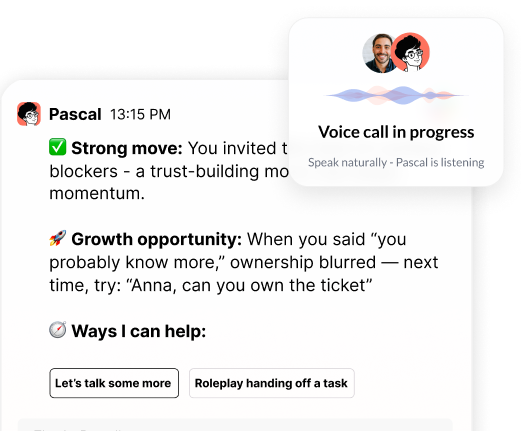
Reactive coaching waiting for managers to ask requires minimal context; proactive coaching surfacing opportunities before managers realize they need help requires understanding team dynamics, communication patterns, and organizational norms deeply enough to recognize when intervention adds value. Real meeting observation provides proactive feedback on actual interactions, not generic frameworks. Consistent engagement creation through proactive nudges builds habits; reactive tools drive inconsistent, low engagement. Contextual timing ensures coaching closest to triggering events drives behavior change; waiting weeks eliminates impact. 94% monthly retention with 2.3 sessions per week reflects engagement when learning is contextually relevant and proactively delivered.
Establish clear policies before deployment: define what data the AI accesses, set escalation thresholds with Legal and IT, ensure cross-functional alignment on sensitive topics, and measure both adoption and behavioral outcomes. Cross-functional governance involving HR, IT, and Legal prevents silos and ensures comprehensive risk management. Transparent communication about data practices addresses employee concerns and builds adoption momentum. Regular audits monitor vendor data pipelines to detect poisoning or model drift affecting coaching quality. Measurement frameworks track leading indicators like session frequency and engagement alongside lagging indicators like manager effectiveness and team performance.
| Governance Element | What It Protects | Implementation Example |
|---|---|---|
| Data access policies | Prevents unauthorized data exposure | Document which systems AI coach can access; audit quarterly |
| Escalation triggers | Ensures human expertise for sensitive topics | Define termination, harassment, medical issues as automatic escalation |
| User transparency | Builds trust and informed consent | Employees can view what data informs their coaching |
| Outcome measurement | Detects problems before they escalate | Track manager effectiveness scores and team engagement metrics |
Purpose-built AI coaching platforms implement user-level data isolation, encryption, escalation protocols for sensitive topics, and transparent governance to protect privacy and foster trust. These aren't optional features for minimally viable AI coaching. They're foundational requirements that determine whether AI becomes a strategic advantage or an organizational liability.
User-level data isolation makes cross-account data leakage technically impossible. Zero customer-data training policies prevent your conversations from improving external models. NIST-standard encryption protects data in transit and at rest. Clear escalation protocols for medical issues, terminations, harassment, and grievances ensure human expertise is involved. Employee transparency controls allow users to view and edit what the AI knows about them.
CHROs leading successful AI transformation recognize that the technology and the guardrails around it are equally important to adoption success. When employees trust that their coaching conversations remain confidential and their data won't be exploited, they engage authentically. That authenticity creates the behavior change that proves ROI.
The organizations getting this right understand that safe learning isn't a constraint on AI coaching. It's the foundation that enables trust, which drives adoption, which delivers measurable outcomes. Book a demo to see how Pascal's architecture, user-level data isolation, SOC2 compliance, and built-in escalation protocols de-risk AI adoption while delivering measurable manager effectiveness improvements.

.png)
.webp)
“Thank you for setting the great foundation for my promotion; now I have a plan!"

Curious to see how AI Coaching can 10X the impact and scale of your development initiatives. Book a demo today for: