

An effective AI coach distinguishes itself through five measurable factors: purpose-built coaching expertise grounded in people science, deep contextual awareness of your people and organization, proactive engagement that surfaces guidance before crises occur, seamless integration into daily workflows, and appropriate guardrails for sensitive topics. Generic tools and poorly integrated solutions consistently underperform regardless of vendor marketing.
Quick Takeaway: The gap between AI coaching that transforms manager effectiveness and AI coaching that becomes shelfware comes down to five specific selection criteria. Platforms combining purpose-built coaching expertise, contextual awareness, proactive engagement, workflow integration, and appropriate escalation protocols deliver measurable behavior change. Those missing even one element typically fail to drive adoption or business outcomes.
At Pinnacle, we've built Pascal specifically to address these criteria because we've learned through working with hundreds of organizations that vendor sophistication directly predicts adoption and impact. The question isn't whether AI coaching works. The question is whether you're selecting a solution that actually delivers the outcomes that matter to CHROs: faster manager ramp time, higher quality feedback conversations, improved performance review consistency, and measurable behavior change from training programs.
Purpose-built coaching platforms are grounded in people science and proven leadership frameworks, while generic AI tools provide lowest-common-denominator advice disconnected from your organization, people, and actual work dynamics. Generic LLMs like ChatGPT compile internet knowledge, creating broad but shallow guidance that misses the nuance of individual human dynamics. Purpose-built systems like Pascal integrate 50+ leadership frameworks backed by behavioral research and are trained by ICF-certified coaches, creating guidance that managers actually trust and apply.
The difference shows up immediately in manager trust and application rates. When a manager asks for help with delegation, a purpose-built coach understands the distinction between coaching a first-time manager toward autonomy versus helping a senior leader develop their team's capability. Generic AI treats all delegation challenges identically.
Research from comparative trials shows that specialized AI coaches outperformed both human coaches and general-purpose AI in six of seven categories, with statistical significance in problem-solving and competence. This distinction matters because management isn't just knowledge transfer. It's behavior change grounded in established frameworks rather than generic advice.
Contextual awareness—integrating individual performance data, team dynamics, and organizational values—eliminates friction and drives sustained engagement that generic platforms cannot achieve. Contextual AI coaches integrate with HRIS, performance reviews, 360 feedback, competency frameworks, and communication tools. Managers don't need to repeatedly explain background information, eliminating the friction that kills adoption in reactive tools.
Organizations using contextually aware AI coaching report 57% higher course completion rates and 60% faster completion times, with satisfaction scores reaching 68%. True personalization means the platform knows team members' communication styles, recent projects, performance history, and career goals based on actual data integration.
Test contextual depth during vendor demos by presenting the same scenario twice with different demographics. Effective platforms adapt while maintaining consistency. Pascal demonstrates this through its proprietary knowledge graph connecting every interaction, insight, and outcome. When a manager asks for help preparing feedback for a specific team member, Pascal already understands that person's communication preferences, recent performance data, and team dynamics based on meeting observations. The guidance becomes tailored to that relationship rather than offering generic talking points.
Proactive systems that deliver feedback after meetings and interactions drive 2-3x higher engagement than reactive tools requiring managers to remember to seek help. Reactive tools see managers try once or twice then abandon. Proactive systems maintain 94% monthly retention with average 2.3 coaching sessions per week. Learning happens when context is fresh and the opportunity to apply insights still exists, not weeks later during scheduled coaching sessions.
Platforms that join meetings, observe team interactions, and deliver real-time feedback create consistent practice loops that drive behavior change. Engagement metrics reveal the difference: platforms driving sustained adoption show weekly usage; passive tools see monthly or quarterly check-ins. Pascal's proactive approach delivers feedback after every meeting, sends weekly curated microlearning based on individual needs, and regularly checks in on development goals. This creates consistent touchpoints that build coaching relationships and reinforce behavior change.
Platforms meeting managers in Slack, Teams, and Zoom eliminate friction and drive adoption; tools requiring separate logins struggle to move beyond early adopters. Workflow integration determines whether coaching becomes a daily habit or another abandoned tool. One tech company using embedded AI coaching estimated saving 150 hours across 50 employees by eliminating tool-switching friction.
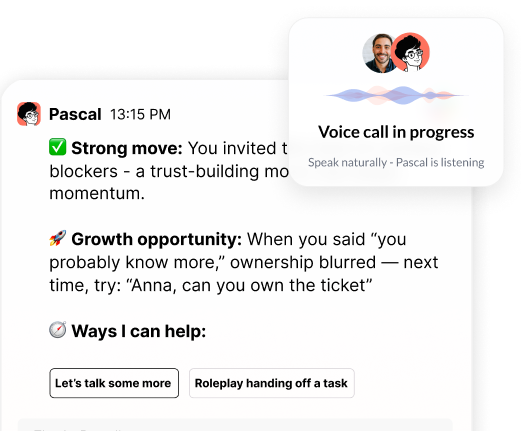
Best solutions live inside tools managers already use dozens of times daily, eliminating context-switching friction. Voice-to-text capabilities enable managers to talk through challenges naturally rather than typing lengthy explanations. Pascal lives inside Slack, Teams, Zoom, and Google Meet because that's where managers spend their days. This integration delivers several adoption advantages: the friction to get coaching drops to nearly zero, Pascal can deliver proactive coaching based on what's actually happening in a manager's work, and coaching feels more like a conversation with a trusted advisor than interacting with software.
Purpose-built coaching systems include moderation and escalation protocols that recognize when situations require HR involvement, protecting organizations while enabling responsible AI adoption. AI can handle up to 90% of routine coaching tasks but should escalate sensitive topics like terminations, harassment, medical issues, and discrimination. Research from The Conference Board confirms that human expertise remains essential for complex, emotionally charged, or culturally nuanced coaching contexts.
Effective guardrails include moderation systems detecting toxic behavior, automatic escalation protocols for sensitive employee topics, and organization-specific controls. Ask vendors: What moderation systems do you have? What happens when queries touch harassment or termination? Can we customize escalation triggers? Pascal has completed SOC2 examination, reinforcing commitment to data security and privacy, while including multiple guardrail layers that politely refuse to provide guidance on sensitive topics while directing users to appropriate HR resources.
Effective platforms track adoption metrics, behavioral change indicators, and business outcomes—not just satisfaction scores or completion rates. 83% of direct reports see measurable improvement in their manager when using purpose-built AI coaching. Highly engaged users experience average 20% lift in Manager Net Promotion Score. Request customer case studies showing adoption rates, manager effectiveness improvements, and team performance gains from organizations similar to yours.
| Evaluation Criterion | What to Look For | Red Flag |
|---|---|---|
| Foundational Expertise | Purpose-built for coaching with people science backing | Generic AI tool repurposed for workplace use |
| Contextual Awareness | Integrates HRIS, performance data, meeting transcripts | Requires managers to re-explain situations each time |
| Engagement Model | Proactive coaching with 2+ sessions weekly | Reactive tool with low monthly engagement |
| Workflow Integration | Lives in Slack, Teams, Zoom | Requires separate portal login |
| Sensitive Topic Handling | Clear escalation protocols to HR | No guardrails or escalation processes |
Leading indicators like session frequency, engagement depth, and feature adoption predict outcomes within 30-60 days. Lagging indicators like manager NPS, direct report engagement scores, and team performance confirm impact over quarters. During vendor demos, test specific scenarios that mirror your actual coaching challenges rather than accepting polished presentations.
Avoid platforms that lack organizational context, operate reactively only, require separate logins, have no escalation protocols for sensitive topics, or promise to replace human coaching entirely. Generic positioning that claims to work for any organization instead of company-specific customization signals the platform prioritizes breadth over depth. No integration with HRIS or performance systems means managers re-explain context repeatedly, creating friction that kills adoption.
Absence of guardrails or escalation paths for harassment, terminations, and mental health concerns creates legal exposure. Claims of replacing human coaches rather than augmenting human expertise indicate misunderstanding of where AI actually adds value. Reliance on satisfaction metrics rather than behavioral or business outcomes means the vendor can't prove real impact.
The organizations winning with AI coaching in 2025 are those treating vendor selection as a strategic decision, not a procurement exercise. They're evaluating not just features but foundations. As Jeff Diana, former CHRO at Atlassian and Calendly, emphasizes, successful AI adoption starts with clear business problems, not the hottest technology.
Start where the need is highest and move quickly to prove value. Pilot with a small group willing to provide honest feedback, measuring both engagement metrics and early outcome indicators. Integrate AI coaching with existing programs rather than treating it as separate. Maintain the hybrid model, using AI to handle foundational development while preserving human coaching for complex work.
The question isn't whether AI coaching works. The evidence is clear that it does when implemented thoughtfully. The question is whether you're selecting a vendor focused on what actually drives results versus what generates impressive demos. Ready to see how purpose-built AI coaching delivers on these criteria? Book a demo with our team to experience how Pascal combines foundational coaching expertise, deep contextual awareness, proactive engagement, and seamless workflow integration to drive the manager effectiveness outcomes that matter to CHROs. Discover why organizations trust Pascal to handle everything from daily 1:1 preparation to complex feedback conversations, with appropriate escalation when human expertise is needed.

.png)
.webp)
“Thank you for setting the great foundation for my promotion; now I have a plan!"

Curious to see how AI Coaching can 10X the impact and scale of your development initiatives. Book a demo today for: