
An AI coach sitting in a separate portal that managers need to remember to visit will be abandoned within weeks. An AI coach embedded in Slack, Teams, and Zoom—where managers already work—becomes a daily habit. The placement question determines whether your investment transforms manager effectiveness or becomes expensive shelfware.
Quick Takeaway: Where your AI coach lives in your organization determines adoption rates, engagement patterns, and whether coaching drives measurable behavior change. Organizations embedding AI coaching directly into collaboration platforms like Slack and Teams see adoption rates 3-5 times higher than standalone portals, with managers averaging 2.3 coaching sessions per week versus less than one monthly for portal-based approaches.
AI coach placement refers to where the system lives in your organizational and technical architecture—whether it operates as a standalone tool, integrates into existing workflows (Slack, Teams, Zoom), connects to HR systems (HRIS, performance management), or combines all three. This decision directly impacts adoption rates, engagement patterns, and whether coaching drives measurable behavior change.
Standalone portals require deliberate action to access, creating friction that kills sustained engagement. Workflow embedding eliminates context-switching and meets managers where they already work. System integration with HRIS and performance platforms enables deep contextual awareness. Proactive coaching surfaces opportunities automatically rather than waiting to be asked. The right placement combines multiple integration levels for maximum impact.
When AI coaches live inside collaboration platforms like Slack and Teams, adoption rates jump to 65-80% compared to 10-20% for standalone portals. This dramatic difference stems from eliminating friction—managers receive coaching in the same tools they check dozens of times daily, without requiring separate logins or context re-explanation.
Workflow embedding reduces the "remembering problem" that defeats most learning tools. Managers using embedded coaches average 2.3 sessions per week versus less than one monthly for portal-based approaches. Integration into daily communication eliminates the need to re-explain team dynamics and organizational context. Proactive nudges in familiar tools feel like helpful guidance rather than a task to complete. Meeting integration enables real-time feedback grounded in actual leadership moments, not hypothetical scenarios.
Successful AI coaching placement requires partnership between HR (who owns talent strategy and coaching outcomes), IT (who manages data security and system integration), and sometimes a Chief Product Officer (who ensures user experience drives adoption). This coalition determines both where the coach lives and how it operates.
HR owns the strategic goal and coaching framework alignment. IT ensures data security, compliance, and system integration without creating silos. The CHRO-CTO-CPO "trifecta" drives transformation more effectively than siloed ownership. Clear governance prevents fragmentation across multiple AI tools and platforms. Cross-functional alignment ensures coaching reinforces organizational priorities rather than working against them.
The optimal placement depends on your primary outcome. Talent development teams typically own coaching strategy. IT co-governs data and integration. Business units may sponsor coaching for transformation initiatives. The strongest implementations place ownership in HR with co-governance from IT and analytics.
HR/Talent ownership ensures coaching aligns with development strategy and business metrics. IT partnership provides technical foundation and data governance without creating bottlenecks. Analytics co-ownership enables measurement of coaching impact against business outcomes. Business unit involvement ensures coaching supports transformation priorities. Avoid isolated ownership; coaching effectiveness depends on cross-functional alignment.
Purpose-built AI coaching platforms are engineered specifically for coaching with proprietary frameworks and behavioral science foundations. Embedded approaches integrate general AI into existing tools. The most effective solutions combine both: coaching expertise grounded in people science, delivered seamlessly into daily workflows where managers already work.
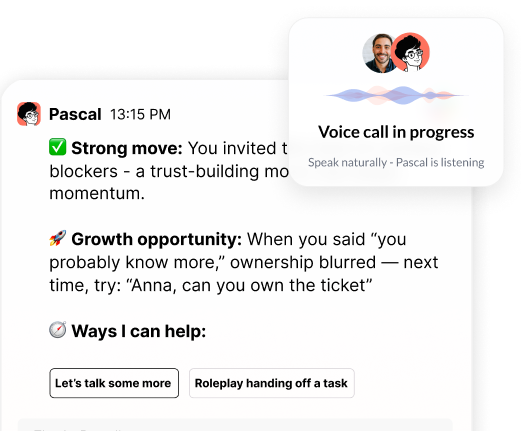
Purpose-built systems include sophisticated guardrails for sensitive topics and proper escalation to HR. Embedded delivery drives adoption by eliminating tool-switching friction. Generic AI adapted for coaching lacks the structured expertise that drives behavior change. Pascal exemplifies the hybrid approach: purpose-built coaching expertise embedded in Slack, Teams, and Zoom. Organizations report 83% of direct reports see measurable improvement in managers using contextual, embedded coaching.
Any AI coach placement must include clear escalation protocols for sensitive workplace topics like harassment, medical issues, or terminations. The system should recognize these topics, refuse to provide guidance, escalate to HR, and help managers prepare for appropriate human conversations.
Moderation systems detect toxic behavior and mental health concerns automatically. Sensitive topic detection identifies when conversations require HR involvement. Organization-specific controls let you define boundaries matching your risk tolerance. Clear guardrails build trust by ensuring AI knows its limits. Escalation to humans protects both employees and the organization.
Start by assessing where your managers already spend time (Slack, Teams, Zoom, email) and which HR systems hold critical context (HRIS, performance management, career development). Embed coaching into those platforms while ensuring IT and HR maintain appropriate governance and data protection.
Identify high-value use cases first (difficult conversations, delegation, performance reviews) rather than broad deployment. Connect the platform to your HRIS, performance system, and communication tools during implementation. Communicate the human-AI partnership explicitly so managers understand when to escalate. Measure both adoption metrics (weekly active users, session frequency) and outcome metrics (manager NPS, direct report engagement).
Iterate based on early signals rather than waiting for perfect setup. Organizations like HubSpot and Zapier demonstrate that successful AI adoption depends on meeting employees where they already work. When embedding is deep and change management is thoughtful, adoption accelerates and measurable behavior change follows.
Key Insight: The placement decision isn't technical—it's strategic. Organizations that embed AI coaching deeply into workflows see adoption rates above 80% and measurable improvements in manager effectiveness within months. Those that treat AI coaching as a standalone tool watch it become another underutilized platform.
Pascal lives where your managers work—embedded in Slack, Teams, and Zoom while integrating with your HRIS and performance systems. This hybrid placement drives the adoption and measurable behavior change that transforms manager effectiveness across your organization. The platform's contextual awareness means coaching personalizes to each manager's situation, their team's dynamics, and your organization's culture. When AI coaching combines behavioral science expertise with seamless workflow integration, managers receive guidance they actually trust and apply.

.png)
.webp)
“Thank you for setting the great foundation for my promotion; now I have a plan!"

Curious to see how AI Coaching can 10X the impact and scale of your development initiatives. Book a demo today for: