

AI coaching transforms managers into confident AI users by embedding personalized guidance into daily workflows, enabling hands-on practice, and creating safe spaces to experiment—turning abstract AI concepts into practical, applied skills.
Quick Takeaway: AI coaching builds AI fluency through three core mechanisms: integrating into daily work where managers already operate, providing just-in-time guidance tied to real situations, and creating consistent practice loops that transform knowledge into behavior change. Organizations that prioritize contextual, proactive AI coaching see managers reaching baseline competency 2-3 times faster than traditional training approaches.
The gap between knowing about AI and actually using it effectively defines the current challenge in most organizations. Only 36% of employees feel adequately trained on AI, according to recent research, largely because traditional training relies on slide decks and compliance modules rather than experiential learning grounded in real work. When 79% of employees receiving more than five hours of AI training become regular users, compared to 67% with less exposure, the message is clear: time matters, but so does how that time gets spent.
AI fluency means managers can recognize where AI adds value, use AI tools effectively for their specific challenges, and lead teams through AI-driven change. The problem isn't that managers don't understand AI conceptually. It's that they lack the confidence born from hands-on practice in contexts that matter to their actual work.
Traditional training disconnects learning from application. A manager sits through a workshop on prompt engineering, returns to their inbox, and encounters a situation where AI could help—but doesn't remember the frameworks or feel confident enough to experiment. The knowledge remains theoretical rather than becoming muscle memory.
The 70-20-10 learning model shows 70% of learning comes from hands-on challenges, 20% from peer relationships, and 10% from formal training. Most organizations invert this ratio, front-loading classroom content while managers lack protected time to actually practice with AI in their daily work. This structural mismatch explains why adoption stalls despite significant training investments.
AI coaching meets managers where they work, providing just-in-time guidance that turns theoretical knowledge into muscle memory through repeated, low-stakes practice in real situations. Rather than attending a training session and hoping the concepts stick, managers encounter coaching at the exact moments they're making decisions that matter.
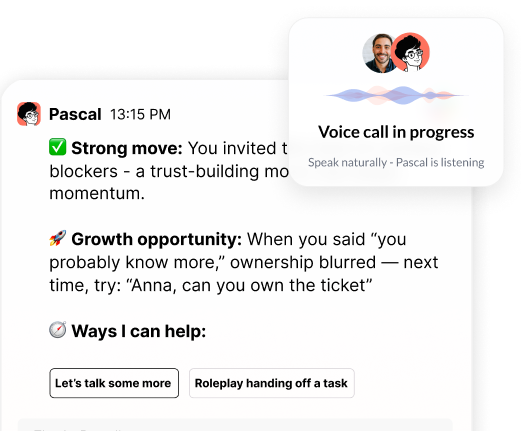
Pascal, Pinnacle's AI coach, enables managers to roleplay difficult conversations, practice delegation, and test approaches before high-stakes interactions. A manager preparing to delegate a complex project can walk through the conversation with Pascal, receive feedback on clarity and empowerment, and refine their approach before the actual conversation happens. This practice-feedback-iteration loop compresses the learning timeline dramatically.
Continuous feedback loops reinforce learning faster than annual training programs ever could. When a manager conducts a team meeting and receives specific feedback within minutes—while context is fresh—the opportunity for behavior change is immediate. Research shows that 83% of direct reports see measurable improvement in their managers when those managers engage regularly with contextual AI coaching, compared to minimal change from traditional training.
Constraint-based challenges unlock creativity and accelerate skill development. Time-boxed exercises with defined outcomes force managers to think differently about problems. When companies like HubSpot and Accenture structure hackathons and gamified challenges around AI adoption, they create permission to experiment without breaking production systems while building intuition through rapid iteration.
Proactive coaching surfaces learning moments in the flow of work, eliminating friction and creating consistent habits that transform managers from passive learners into confident, independent AI users. Rather than waiting for managers to recognize they need help and seek it out, effective AI coaching identifies opportunities and delivers relevant guidance automatically.
Reactive tools see adoption drop after initial novelty; proactive systems maintain engagement by delivering feedback when it's most relevant. Pascal joins meetings and delivers real-time feedback, helping managers recognize patterns they wouldn't see alone. This observational capability means managers receive coaching not just when they ask for help, but when they actually need it—in the middle of making decisions.
Contextual awareness makes coaching specific and immediately applicable rather than generic. Organizations using context-aware AI coaching report 83% of direct reports see measurable improvement in their managers, with managers averaging 2.3 coaching sessions per week. This engagement level indicates the tool has become part of regular workflow, not a resource managers remember to visit occasionally.
Proactive engagement creates consistent touchpoints that build habits. Managers developing AI fluency need repeated exposure, feedback, and opportunities to apply learning. When Pascal surfaces coaching opportunities after every meeting, sends weekly curated guidance based on individual development needs, and follows up on progress toward AI competency goals, the consistent reinforcement transforms abstract concepts into practiced skills.
Safe, structured experimentation within AI coaching reduces psychological barriers and builds confidence, enabling managers to move from skepticism to fluency through low-risk practice. Fear of AI and uncertainty about appropriate use cases prevent adoption more than technical limitations ever could.
Hackathons and gamified challenges create permission to experiment without breaking production systems. When HubSpot and Accenture structure AI adoption as exploration rather than compliance, they reduce the anxiety that freezes decision-making. Managers discover through experimentation that AI tools are less intimidating than they imagined.
AI coaches provide guardrails for sensitive topics, escalating appropriately to HR while building manager confidence for routine challenges. When managers know that certain conversations will be routed to human expertise—harassment concerns, terminations, medical accommodations—they trust the system to protect both themselves and their employees. This appropriate escalation actually increases confidence because managers understand the boundaries.
Recognition and community sustain engagement. Leaderboards showing peer adoption, internal sharing of successful AI use cases, and celebration of managers who've achieved AI fluency create social proof that normalizes AI use across organizations. When managers see peers successfully using AI, the perceived risk drops significantly.
Sandbox environments enable practice with AI before deploying it with teams. Managers can experiment with different prompts, test approaches, and build competence in low-stakes settings. This practice phase reduces the anxiety of using AI for the first time with actual team members because managers have already developed muscle memory.
Organizations that integrate AI coaching into daily workflows, embed AI expectations into performance frameworks, and create peer learning communities see enterprise-wide fluency development rather than isolated pockets of adoption. The difference between companies where AI fluency spreads and those where it remains concentrated in early adopters comes down to systematic enablement.
Integration into existing tools eliminates friction. When coaching is embedded in Slack, Teams, or Zoom rather than requiring separate logins, managers engage 2.3 times per week versus less than once monthly for standalone platforms. This difference in engagement frequency directly determines whether fluency develops or remains theoretical.
Making AI proficiency part of performance reviews creates accountability without mandating specific usage levels. When managers know that demonstrating AI competency factors into their evaluation, they prioritize developing these skills. Organizations like HubSpot embed AI expectations into their performance frameworks, signaling that these capabilities matter for career progression.
Peer sharing rituals accelerate learning through social proof and horizontal knowledge transfer. Weekly demos where managers show what they've built with AI, monthly hackathons, and internal communities of practice create visibility into what's possible. When managers see colleagues successfully using AI, adoption accelerates because the perceived barrier drops.
Clear communication about why AI matters and what's in it for managers personally drives adoption more than abstract business cases. Managers need to understand how AI fluency makes their jobs easier—reducing time spent on routine tasks, improving decision quality, or enabling them to focus on higher-impact work. When the personal benefit is clear, motivation follows.
HR teams that position themselves as enablers rather than enforcers build trust and sustained engagement. When people teams support experimentation, celebrate learning, and help managers navigate challenges rather than enforcing compliance, the culture shifts from resistance to curiosity.
Pascal combines purpose-built coaching expertise, contextual awareness of your people and workflows, and proactive engagement to transform managers from uncertain about AI to confident, independent users who naturally integrate AI into how they lead.
Purpose-built design means Pascal draws from 50+ leadership frameworks and people science rather than generic internet knowledge. When Pascal coaches a manager on AI-enabled delegation, it grounds guidance in established models, not crowdsourced advice. This foundation ensures managers trust the coaching enough to apply it.
Contextual integration with your HRIS, performance data, and meeting transcripts enables personalized guidance grounded in actual situations. Pascal knows each manager's team, current projects, communication patterns, and development goals. The coaching reflects reality rather than offering one-size-fits-all advice.
Proactive surfacing of coaching moments means managers receive guidance before they realize they need it. After a team meeting where a manager could have better leveraged AI for decision-making, Pascal offers specific feedback. This consistent, timely intervention builds habits that stick.
Guardrails that escalate sensitive topics to HR while building manager confidence for routine challenges protect both the organization and employees. Managers learn to use AI effectively for appropriate situations while understanding when human judgment is required.
Workflow integration in Slack, Teams, and Zoom means coaching happens where managers already work. Voice-based interactions enable managers to talk through challenges naturally, and embedded prompts surface guidance at decision moments. This seamless integration drives the engagement frequency that builds fluency.
Progress tracking and organizational insights help HR leaders measure fluency development and demonstrate ROI. Rather than hoping AI coaching drives behavior change, you can see exactly which managers are engaging, what they're working on, and how their teams respond.
The result is transformation from abstract understanding to practical competency. Managers move from "I've heard about AI" to "I use AI regularly to improve how I lead." That shift—from awareness to fluency—is what drives organizational capability and competitive advantage.
Ready to see how AI coaching can build genuine AI fluency across your management team? Book a demo to experience how Pascal meets managers where they work with contextual, proactive guidance that transforms them from uncertain to confident AI users—and see the specific moments where fluency clicks into place.

.png)
.webp)
“Thank you for setting the great foundation for my promotion; now I have a plan!"

Curious to see how AI Coaching can 10X the impact and scale of your development initiatives. Book a demo today for: