

An AI coach living in a separate portal that managers need to remember to visit will be abandoned within weeks. An AI coach embedded in Slack, Teams, and Zoom—where managers already work—becomes a daily habit. The integration strategy you choose determines adoption rates, engagement patterns, and whether coaching drives measurable behavior change.
Quick Takeaway: Integration refers to where your AI coach lives in your organizational and technical architecture. Workflow embedding (Slack, Teams, Zoom) eliminates context-switching friction and drives 65–85% adoption, compared to 10–20% for standalone portals. Organizations with multi-platform integration see 70–85% adoption and measurable behavior change; those with single-layer integration see 30–50%; standalone tools plateau at 10–20%.
The difference between effective AI coaching and expensive shelfware comes down to one critical decision: where your coach actually lives. We've seen this pattern repeatedly across organizations deploying AI coaching solutions. The platforms that drive real adoption and outcomes integrate deeply with company systems and embed seamlessly into daily workflows. Those that don't become another tool managers tried once and abandoned.
Integration refers to where your AI coach lives in your organizational and technical architecture—whether it operates as a standalone tool, connects to your workflow platforms (Slack, Teams, Zoom), integrates with HR systems (HRIS, performance management), or combines all three. This decision directly impacts adoption rates and business outcomes.
Standalone portals require deliberate action (logging in, explaining context) and see adoption rates of 10–20%. Managers need to remember the tool exists, navigate to it separately, and re-explain their situation each time they seek guidance. The friction kills engagement. Workflow embedding (Slack, Teams) eliminates context-switching and drives 65–85% adoption because coaching appears where managers already work dozens of times daily. HRIS and performance system integration enables deep contextual awareness without repetition. Meeting platform integration enables observation-based feedback grounded in actual leadership moments. Proper escalation protocols ensure human expertise handles sensitive topics like harassment or terminations.
Organizations embedding AI throughout the employee lifecycle see adoption rates above 80% and measurable improvements in manager effectiveness. The integration strategy you choose determines whether your investment becomes a trusted daily resource or another underutilized tool.
AI coaches embedded directly into Slack, Teams, and Zoom see adoption rates 3–5x higher than standalone portals because they eliminate the "remembering problem" and deliver guidance at teachable moments. Managers using deeply integrated coaches average 2.3 sessions per week versus less than one monthly for portal-based tools.
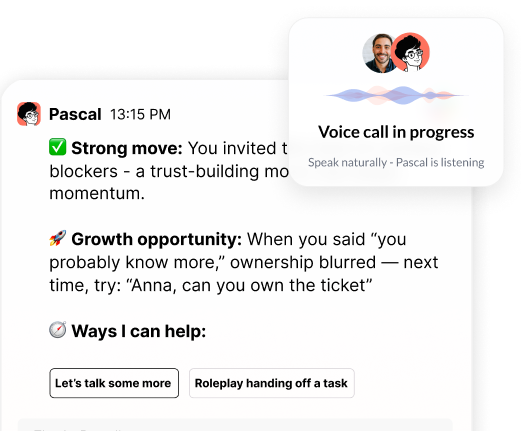
Slack and Teams embedding makes coaching one click away in tools managers check dozens of times daily. Rather than opening another app, managers engage with their coach in the same threads where team discussions happen. This reduces friction to near-zero. Meeting integration allows real-time observation of leadership behavior and immediate feedback after interactions, when learning sticks best. Voice functionality enables managers to talk through challenges naturally rather than typing lengthy explanations. Proactive notifications surface coaching opportunities before managers realize they need help, creating consistent development habits rather than crisis-only support.
Contextual awareness eliminates friction—managers don't need to repeatedly explain their situation, their team dynamics, or their company's approach. When Pascal lives in Slack or Teams, managers maintain 94% monthly retention with an average of 2.3 coaching sessions per week. This engagement level indicates the platform has become part of their routine, not an occasional resource.
Native integrations with HRIS, performance management systems, and goal-setting platforms create the contextual foundation that makes coaching specific to actual people and situations rather than generic scenarios.
Real-time HRIS sync ensures the coach knows current reporting structures, tenure, and role changes without requiring managers to explain organizational context. Performance review access provides historical context for developmental coaching and identifies patterns across feedback themes. Goal-setting system integration connects coaching to individual aspirations and career plans, personalizing guidance toward what matters to each person. 360 feedback data informs personalized coaching on specific strengths and development areas. Calendar integration enables proactive coaching before high-stakes conversations and one-on-ones, surfacing preparation support exactly when managers need it.
Pascal maintains native integrations with leading HRIS and performance management platforms, automatically syncing data so the coaching reflects current organizational reality. This eliminates the manual data entry and context re-explanation that kill adoption in loosely integrated systems.
Purpose-built AI coaches include moderation systems and escalation integrations that detect sensitive topics and route them to HR rather than attempting to provide guidance on harassment, medical issues, terminations, or grievances.
Automatic detection of sensitive employee topics triggers HR escalation while helping managers prepare for those conversations. Moderation flags toxic behavior, harassment, or mental health concerns and directs users to appropriate resources. Customizable guardrails let you define which topics the AI won't respond to, creating a walled garden you control. SOC2 compliance and enterprise-grade encryption protect data while escalation protocols ensure appropriate human expertise involvement. Data stored at user level makes cross-user information leakage technically impossible.
These guardrails address real risks. Generic LLMs will provide termination scripts if asked, potentially exposing organizations to wrongful termination claims. Purpose-built coaches won't allow this, escalating appropriately and involving HR teams in sensitive processes. This de-risks AI adoption by ensuring appropriate expertise is involved when it matters most.
Integration depth directly predicts adoption rates and business impact. Organizations with multi-platform integration (workflow tools plus HRIS plus meetings plus escalation) see 70–85% adoption and measurable behavior change; those with single-layer integration see 30–50%; standalone tools plateau at 10–20%.
Workflow-only integration (Slack/Teams without HRIS connection) drives adoption but limits personalization. Managers engage frequently but receive generic guidance because the system lacks context about their people and situations. HRIS-only integration enables personalization but requires managers to seek help proactively, missing the teachable moments when coaching matters most. Meeting-only integration provides observation-based feedback but lacks daily accessibility. Full ecosystem integration connects HRIS, performance management, communication platforms, and meeting tools to pull real-time signals, making coaching the most embedded and context-rich.
Organizations see 83% of direct reports report measurable improvement in their manager when integration depth enables truly personalized, proactive coaching. This improvement concentrates among managers who needed development most, indicating that contextual integration targets guidance precisely where it creates value.
Ask vendors which systems they connect to natively versus through manual data export, how frequently data syncs, whether the platform requires separate logins, and what guardrails protect sensitive topics. Integration depth determines adoption more than feature sophistication.
Request specific examples of how integrations inform coaching in real scenarios. Test whether setup requires IT involvement or can launch in days. Verify whether the coach lives in existing tools or requires managers to adopt a new platform. Confirm data security protocols and compliance certifications (SOC2, GDPR). Evaluate how the platform handles escalation for sensitive workplace topics. The organizations that see the highest ROI from AI coaching prioritize deep integration, company-specific data access, and privacy-conscious design.
During vendor demos, test specific scenarios that mirror your actual coaching challenges. Ask vendors to roleplay a difficult conversation and observe whether they ask clarifying questions, reference organizational context, and provide specific talking points rather than generic frameworks. This reveals whether integration depth enables truly contextual coaching or just surface-level personalization.
Ready to see how integration depth transforms AI coaching from a nice-to-have into a daily habit that drives measurable manager effectiveness? Book a demo to explore how Pascal integrates across Slack, Teams, and Zoom while connecting to your HRIS and performance management systems—delivering personalized, proactive coaching grounded in your organizational data and culture.

.png)
.webp)
“Thank you for setting the great foundation for my promotion; now I have a plan!"

Curious to see how AI Coaching can 10X the impact and scale of your development initiatives. Book a demo today for: