

People teams need clear visibility into adoption patterns, engagement depth, skill development, behavior change, and organizational insights from AI-powered learning tools, not just completion rates. Without this data, HR leaders cannot prove ROI or identify which programs actually drive performance improvement. The most effective platforms surface five critical data layers: adoption metrics revealing consistent usage patterns, engagement depth showing whether learning sticks, skill development evidence demonstrating capability improvement, organizational pattern recognition identifying systemic gaps, and transparent data governance protecting privacy while enabling personalization.
Quick Takeaway: Effective AI-powered learning tools surface five critical data layers: adoption metrics revealing consistent usage patterns, engagement depth showing whether learning sticks, skill development evidence demonstrating capability improvement, organizational pattern recognition identifying systemic gaps, and transparent data governance protecting privacy while enabling personalization. Organizations that demand this visibility see measurable returns on learning investments; those settling for vanity metrics get expensive experiments that fail to drive behavior change.
In our work with organizations implementing AI coaching at scale, we've observed a clear pattern. People teams that define what data they need upfront and hold vendors accountable to providing it see dramatically better outcomes than those who accept whatever dashboards vendors offer by default. The difference between knowing whether your learning investment actually works and wondering if it's making any impact comes down to asking the right questions about data visibility before you implement.
Adoption metrics reveal whether tools drive consistent usage; engagement depth (not login frequency) predicts sustained behavior change versus abandonment within weeks. Daily active users and session frequency show adoption patterns, but the real signal comes from understanding which managers engage 2+ times weekly versus those who try once and abandon the tool.
Organizations using contextual AI coaching maintain 94% monthly retention with an average of 2.3 coaching sessions per week, far exceeding typical learning platform engagement. Time spent per session and feature usage reveal which guidance managers actually apply versus skip. Escalation patterns to HR show where managers struggle most and where guardrails are working. Cohort analysis comparing early adopters, late adopters, and resisters identifies change readiness and reveals which teams need additional support.
Session depth matters more than login frequency. People teams should track time spent per session, which features managers actually use, and whether engagement is proactive (managers seeking help) or reactive (only using the tool when forced). Completion rates by content type reveal which guidance resonates versus what gets skipped. One tech company estimated 150 hours saved in the first quarter with a 50-person rollout, stemming from eliminated redundant training and decreased HR escalations for routine management questions that AI coaching handled effectively.
Evidence of actual capability improvement requires pre/post assessments, 360 feedback integration, and correlation with business outcomes, not just content consumption. Leading indicators like coaching session frequency and skill application predict lagging outcomes like performance improvement and retention.
AI-assisted workers completed 66% more output in the same time, with customer service agents resolving 14% more issues per hour, demonstrating that effective learning tools drive measurable productivity gains. Manager Net Promoter Score tracking reveals whether coaching translates to observable behavior change that teams perceive. Skill gap closure metrics tied to your competency frameworks answer: are we closing the gaps that matter most?
Time-to-competency for new managers measures how quickly learning accelerates development compared to traditional approaches. 48% of employees say formal AI training would most increase their daily use, signaling that visibility into training effectiveness drives better program design. Pre- and post-coaching assessments on specific competencies like delegation, feedback quality, and conflict resolution provide quantifiable evidence of development. 360 feedback trends demonstrate whether coaching produces behavioral shifts that peers and direct reports actually notice.
Aggregated, anonymized insights surface systemic skill gaps and team health signals while protecting individual privacy, enabling proactive HR strategy rather than reactive crisis management. This organizational intelligence enables People teams to shift from reactive training to proactive capability building.
Anonymized trend reports showing which competencies need development across the organization (only generated with 25+ users to protect privacy) reveal where to invest in targeted development programs. Team-level patterns identifying which managers struggle most with feedback, delegation, or conflict resolution identify where coaching is having the most impact. Emerging risk flags alert HR when multiple managers ask about harassment, performance issues, or other sensitive topics. Skill readiness dashboards showing organizational preparedness for strategic initiatives or role transitions enable proactive workforce planning.
68% of managers recommended gen AI for team challenges, with 86% reporting success in resolution, indicating that visible coaching effectiveness drives broader adoption. Correlation analysis between coaching engagement and business outcomes proves the ROI that CFOs need to see. Without this organizational visibility, HR teams operate blindly, unable to demonstrate strategic impact or identify where systemic challenges require intervention beyond individual coaching.
Purpose-built platforms isolate data at the user level, never train on customer data, and include escalation protocols for sensitive topics, building employee trust while enabling personalization that makes coaching effective. This architecture ensures contextual coaching doesn't create surveillance concerns.
Platforms maintaining SOC2 compliance commit to never training AI models on customer data, protecting confidentiality while enabling coaching personalization. User-level data isolation prevents cross-account leakage where one manager's conversations could expose another's information. Customizable guardrails allow you to define which topics trigger escalation to HR: harassment, medical issues, terminations. Individual user controls giving employees visibility into what the AI knows about them build confidence rather than creating surveillance concerns. Clear escalation protocols for sensitive topics, documented and auditable, protect both your organization and your people while de-risking AI adoption.
Regular security audits and penetration testing with transparent reporting demonstrate that the vendor takes data protection seriously. People teams should require vendors to commit in writing to never using customer data for training external AI models and to provide data export and deletion guarantees if the contract terminates. This transparency builds the trust that makes people willing to engage authentically with AI coaching.
Move beyond vendor claims to scenario-based evaluation and contractual verification of data protection, contextual integration, and business outcome measurement. The vendor selection process directly predicts implementation success and ROI.
Request sample dashboards showing adoption, engagement, skill development, and organizational patterns before implementation. Ask how the platform measures behavior change, not just content consumption, and verify it distinguishes between superficial and sustained engagement. Verify that platforms provide aggregated insights without exposing individual coaching conversations and confirm data residency, encryption standards, and compliance certifications like SOC2, GDPR, and CCPA.
Test how the platform handles sensitive topics by asking specific scenarios: a manager describing potential harassment, an employee disclosing mental health concerns, a conversation about termination. Evaluate whether insights are actionable for HR strategy or just vanity metrics that look impressive in presentations but don't drive decisions. Companies like HubSpot, Zapier, and Marriott succeeded by embedding AI into existing workflows and making clear that technology augments rather than replaces human judgment.
| Evaluation Criteria | What to Ask | Red Flags |
|---|---|---|
| Data Access | What systems does the platform connect to? How does it use organizational context? | Vague answers; limited integrations; generic guidance |
| Adoption Metrics | Can you see daily active users, session frequency, and engagement depth by user? | Only completion rates; no engagement depth; no cohort analysis |
| Behavior Change Measurement | How do you measure whether coaching translates to actual skill improvement? | No pre/post assessments; only survey data; no 360 integration |
| Privacy & Security | SOC2 certified? User-level data isolation? Never train on customer data? | No certifications; vague data policies; model training on customer data |
| Organizational Insights | Can you see anonymized patterns about skill gaps and team health? | Only individual dashboards; no aggregated insights; no risk flagging |
The most sophisticated platforms combine individual coaching visibility with organizational pattern recognition, enabling People teams to shift from reactive training to proactive capability building. This requires balancing personalization with privacy through thoughtful data governance and transparent design.
Purpose-built learning platforms like those used by HubSpot, Zapier, and Marriott embed learning into workflows while surfacing the data that matters: adoption, skill development, behavioral change, and organizational health. The platforms succeeding long-term understand that visibility isn't about surveillance. It's about giving People teams the intelligence they need to design better development experiences while protecting the trust that makes coaching effective.
When managers know their coaching conversations remain confidential, they engage authentically. When HR leaders can see aggregate patterns without exposing individuals, they make better strategic decisions. When both layers work together—individual trust and organizational insight—learning investments finally deliver measurable returns.
"If we can finally democratize coaching, make it specific, timely, and integrated into real workflows, we solve one of the most chronic issues in the modern workplace."
Book a demo to explore how Pascal's integrated data approach transforms how you measure and improve manager effectiveness at scale, delivering real-time adoption metrics, skill development tracking, and anonymized organizational insights while maintaining enterprise-grade privacy protections.

.png)
.webp)
“Thank you for setting the great foundation for my promotion; now I have a plan!"

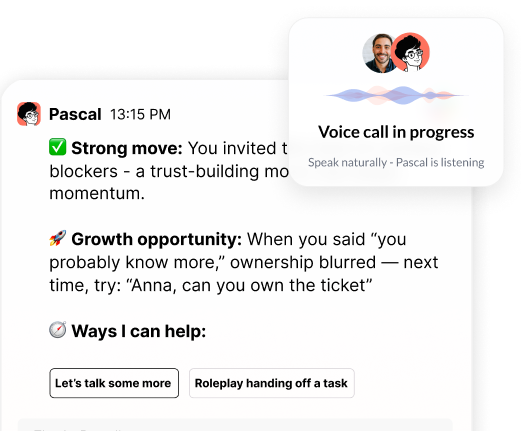
Curious to see how AI Coaching can 10X the impact and scale of your development initiatives. Book a demo today for: