

An AI coach that doesn't understand your culture is just a chatbot. The difference between a coaching system that becomes a daily resource and one that collects digital dust comes down to whether the platform knows your people, your values, and how work actually happens in your organization. Context isn't a feature you add later. It's the foundation that determines whether managers trust the guidance enough to change their behavior.
Quick Takeaway: Effective AI coaches integrate four layers of organizational knowledge: your documented values and competency frameworks, performance and development data from your HR systems, real-time team dynamics from meetings and communication patterns, and the timing of critical moments like performance reviews and goal-setting cycles. Without this foundation, coaching remains generic and managers abandon the tool within weeks.
In our work building Pascal and implementing AI coaching across organizations ranging from 100 to 5,000 employees, we've observed a clear pattern. Platforms that integrate deeply with company data drive sustained engagement and measurable outcomes. Those that operate in isolation from your organization's reality become expensive experiments that managers try once and abandon. The question for CHROs isn't whether AI coaching can work. It's whether your chosen platform has the contextual awareness to make guidance relevant enough that managers apply it immediately.
Purpose-built AI coaches integrate performance reviews, 360 feedback, career goals, company values, competency frameworks, meeting transcripts, and communication patterns to understand your specific organizational context rather than applying generic best practices. This isn't about collecting data for surveillance. It's about eliminating the friction that kills adoption.
Research shows organizations using AI-powered training with company-specific data report 57% higher course completion rates, 60% shorter time to competency, and 68% higher satisfaction scores. These improvements stem directly from relevance. When guidance addresses a manager's actual situation within their actual culture, they apply it immediately rather than trying to translate generic advice into their context.
Pascal achieves this integration through five specific data layers. First, individual employee data including role, level, career aspirations, past performance feedback, and communication preferences create the foundation for personalization. Second, organizational knowledge including values statements, competency models, culture documentation, and leadership principles ensure coaching reinforces how your organization defines success. Third, real-time work context from meeting dynamics, team interaction patterns, and communication styles observed through actual interactions ground coaching in observable behavior rather than hypothetical scenarios.
Fourth, temporal context matters enormously. Performance review cycles, pulse surveys, goal-setting seasons, and compensation conversations create natural moments when managers need coaching most. Fifth, training materials and internal frameworks your company prioritizes ensure Pascal reinforces your shared language rather than introducing conflicting approaches. Organizations using contextual AI coaching maintain 94% monthly retention with an average of 2.3 coaching sessions per week, far exceeding typical engagement rates for generic tools.
Generic AI tools provide the same advice to every user regardless of role or organizational context. Culture-aware AI coaches synthesize your specific company data to deliver guidance that reflects how leadership actually works in your environment, not universal best practices that may or may not apply to your situation.
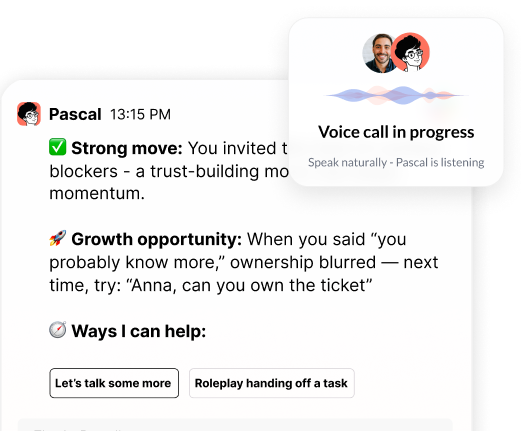
When a manager asks ChatGPT for help with a difficult conversation, they receive templated frameworks disconnected from that team's actual dynamics. Pascal, by contrast, references specific moments from recent interactions and suggests improvements grounded in observed behavior. The coaching addresses their specific challenge with their specific team member in your specific culture.
"57% of professional coaches believe AI cannot deliver real coaching when divorced from organizational context."
This skepticism reflects experience with generic tools that provide theoretically sound advice disconnected from how your organization actually operates. When coaching guidance conflicts with organizational norms, managers face an impossible choice: follow the AI's advice and violate cultural expectations, or ignore the tool entirely. Most choose the latter, which is why adoption collapses with context-free platforms.
| Capability | Generic AI (ChatGPT) | Contextual AI Coaching (Pascal) |
|---|---|---|
| Data sources | Public knowledge bases only | Performance data, team feedback, meetings, company documentation |
| Personalization | Same advice for all users | Adapts to role, tenure, goals, team dynamics, and company values |
| Engagement pattern | Reactive (user must initiate) | Proactive (surfaces opportunities after meetings) |
| Typical adoption | Declines after initial trial | 94% monthly retention with sustained engagement |
Purpose-built platforms identify when critical moments happen in your organization's calendar and proactively surface coaching at those exact moments when managers need it most. Proactive engagement eliminates the friction that kills adoption; coaching appears when and where managers actually face challenges.
Pascal tracks organizational rituals and delivers just-in-time coaching reminders tied to your company's specific timeline. When performance review season approaches, Pascal proactively offers to help managers prepare rather than waiting for them to remember to ask. This timing matters because coaching arrives when context is fresh and implementation is straightforward.
Consistency comes from guidance that addresses actual challenges at moments of maximum relevance. Managers return because the coaching addresses their immediate needs, not hypothetical scenarios. One tech company estimated 150 hours saved in the first quarter with a 50-person rollout, stemming from eliminated redundant training and decreased HR escalations for routine management questions that Pascal handles effectively.
Key Insight: Timing transforms coaching from theoretical to tactical. When guidance arrives at moments of maximum relevance, managers apply it immediately rather than trying to remember lessons from training sessions weeks earlier.
Purpose-built platforms store data at the user level, maintain explicit consent protocols, include escalation procedures for sensitive topics, and never train AI models on customer data. This architecture ensures personalization doesn't create surveillance concerns that erode employee trust and adoption.
Data encrypted and stored individually makes cross-user data leakage technically impossible. Coaching conversations remain confidential unless the employee explicitly shares insights. Customer data never trains underlying AI models or any third-party LLM providers. All data is encrypted with enterprise-grade protection, and compliance with SOC2 standards comes standard.
By 2027, at least one global company is predicted to face an AI deployment ban due to data protection non-compliance, making robust privacy architecture a business-critical requirement. Automatic escalation for sensitive topics like harassment, medical issues, or terminations ensures appropriate human expertise engages when stakes are high. This protective layer de-risks AI adoption by ensuring legal and ethical boundaries remain intact.
Organizations using contextual AI coaching report faster manager ramp time, higher quality feedback conversations, improved review consistency, and sustained behavior change because relevance drives immediate application. These aren't soft metrics. They directly impact the business outcomes CHROs need to deliver.
83% of direct reports report measurable improvement in their managers when those managers engage regularly with contextual AI coaching. 20% average lift in Manager Net Promoter Score among highly engaged users shows that coaching relevance translates to team perception of manager effectiveness. 34% time savings per employee monthly (45 hours) when AI handles routine coaching frees HR teams to focus on strategic work.
When managers receive guidance tailored to their specific challenges, they apply it immediately rather than trying to translate generic advice into their context. Melinda Wolfe, former CHRO at Bloomberg and Pearson, emphasizes that "if we can finally democratize coaching, make it specific, timely, and integrated into real workflows, we solve one of the most chronic issues in the modern workplace."
Ask specific questions about what data the platform accesses, how it protects privacy, and how it uses organizational context to personalize guidance rather than relying on feature lists or vendor claims. The right vendor selection determines whether you get a strategic asset or expensive shelfware.
What systems does the platform connect to? Does it access HRIS, performance data, communication patterns, and company documentation? How does the platform handle data isolation and prevent cross-user leakage? Can you customize the AI with your company's values and competency frameworks to ensure coaching aligns with your culture? What escalation protocols exist for sensitive topics, and can you configure which topics trigger human involvement?
Does the platform provide aggregated, anonymized insights to HR teams about skill gaps and development patterns? Three veteran CHROs recently joined Pinnacle as strategic advisors specifically because they recognized that purpose-built platforms with proper context, guardrails, and organizational alignment deliver measurably better outcomes than generic tools.
"With AI you can delegate the work, you cannot delegate the accountability."
This principle applies directly to vendor selection. The platform should handle routine coaching while your HR team retains oversight on sensitive decisions and strategic initiatives. Companies like HubSpot, Zapier, and Marriott succeeded by embedding AI into existing workflows and making clear that the technology augments rather than replaces human judgment.
The difference between transformative AI coaching and expensive experiments comes down to context. Pascal integrates with your HRIS and communication tools to deliver personalized guidance grounded in actual employee data, team dynamics, and your company's culture while maintaining strict privacy protections and appropriate escalation for sensitive topics. Book a demo to explore how Pascal learns your organization and delivers coaching that managers trust and apply immediately.

.png)
.webp)
“Thank you for setting the great foundation for my promotion; now I have a plan!"

Curious to see how AI Coaching can 10X the impact and scale of your development initiatives. Book a demo today for: