

Organizations that prepare their culture for AI-enabled management prioritize leadership clarity, psychological safety, and human-AI collaboration frameworks over technology deployment alone, resulting in measurable improvements in engagement and manager effectiveness. The shift from managing people to orchestrating hybrid human-AI teams requires rethinking leadership roles, employee development, and organizational rituals around how work actually gets done. Culture determines whether managers embrace AI as a tool that enhances their work or resist it as a threat to their roles.
Quick Takeaway: Organizations with leadership-driven AI strategies see 62% of employees fully engaged compared to 50% in the next highest category. Employees in structured adoption environments are 7.9x more likely to view AI positively (79% vs. 10%). The gap between AI adoption and cultural readiness determines whether transformation succeeds or stalls.
The numbers reveal a persistent challenge: 70% of AI implementation challenges arise from people and process issues, not technical ones. Yet most organizations rush to deploy technology before addressing the cultural foundations that determine whether managers and employees will actually use it. At Pinnacle, we've spent years working with CHROs navigating this gap, and we've learned that culture preparation isn't a soft skill initiative. It's the strategic prerequisite that determines whether AI becomes a trusted daily resource or an expensive tool that employees actively avoid.
AI-enabled management redefines hybrid work as humans and AI agents collaborating on tasks, with managers orchestrating both human teammates and AI systems while maintaining accountability for outcomes. This shift requires rethinking leadership roles from directing people to directing work—where some tasks are handled by humans, some by AI, and many by both together. The manager's job transforms from sole decision-maker to system architect who understands which work belongs where.
Helen Russell at HubSpot frames this as intentional redefinition: "If you redefine hybrid as humans and agents, then we've made a statement that this is what we believe to be true." This statement matters because it signals to the entire organization that AI collaboration isn't experimental or optional. It's foundational to how work gets done.
Managers become orchestrators rather than sole decision-makers, coordinating human judgment with AI capabilities. The employee lifecycle—from hiring to promotion—gets redesigned around this new reality. Three global companies show how embedding AI into onboarding, feedback, and career development creates consistency across the entire employee journey rather than treating AI as a standalone tool.
Culture determines whether managers and employees embrace AI as a tool that enhances their work or resist it as a threat to their roles. Organizations with leadership-driven AI strategies see 62% of employees fully engaged, compared to 50% in the next highest category. More striking, employees in structured adoption environments are 7.9x more likely to view AI positively (79% vs. 10%).
These gaps exist because culture shapes whether managers see AI coaching as support or surveillance. Trust levels determine adoption speed; psychological safety enables experimentation. CHROs can build this trust by moving from crisis management to strategic AI leadership, positioning AI as augmentation that makes human work more strategic. Connections must come before content—people need to understand how AI connects to business goals and personal benefits before engaging with technology.
Leaders must reframe AI as augmentation that makes human work more strategic, not replacement that eliminates jobs. Framing matters enormously because employee anxiety about job security directly impacts adoption. HR teams thinking like product organizations focus on employee experience and answer the question "What's in it for me?" with concrete benefits like eliminating unwanted work rather than abstract productivity gains.
Brandon Sammut at Zapier emphasizes: "With AI you can delegate the work, you cannot delegate the accountability." This becomes the core message that distinguishes AI adoption from abdication of leadership responsibility. Embed AI expectations into existing performance frameworks rather than creating new ones. Celebrate early wins through peer sharing and internal storytelling so skeptics see that AI actually works in your environment.
Hackathons and hands-on experimentation build confidence faster than training modules because people learn through doing rather than listening. 46% of employees at organizations with comprehensive AI-driven redesign express job security worries, requiring transparent communication about role evolution and concrete examples of how AI creates new opportunities rather than eliminating them.
Organizations must redefine performance expectations, update leadership competencies, and create rituals that normalize AI collaboration. Gail Fierstein (former CHRO, Goldman Sachs, Pearson) explains: "What companies and HR need to do is define what is performance and potential in the context of the human-AI collaborative. It's different."
Update the nine-box to include AI fluency and human-AI orchestration skills. Build guardrails and escalation protocols so managers know when to involve humans versus delegating to AI. Create cross-functional coalitions (CHRO, CTO, Chief Product Officer) to shape policy and remove barriers. HR teams modeling product organizations can iterate on adoption based on real usage patterns rather than treating implementation as a one-time event. 67% of organizations are culturally and operationally unprepared for AI transformation; intentional cultural preparation bridges this gap.
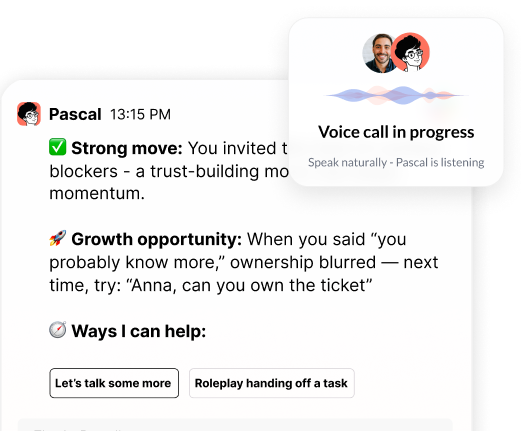
Purpose-built AI coaching platforms integrate into daily workflows, provide real-time feedback on human-AI collaboration moments, and model the behaviors leaders want to see. Rather than waiting for formal training, managers learn by doing—with AI support embedded in the moments they actually need it. Pascal joins meetings and surfaces feedback after interactions, normalizing continuous learning without requiring managers to remember to seek help.
Coaching guidance can be customized to your organization's values and leadership frameworks, reinforcing cultural consistency across the entire management population. Starting with specific tasks rather than broad transformation reduces fear and builds confidence before expanding to more complex applications. AI coaching provides organizational insights (aggregated, anonymized) that help HR leaders identify skill gaps and emerging challenges before they escalate into larger problems.
| Cultural Element | Traditional Approach | AI-Enabled Approach |
|---|---|---|
| Performance expectations | Annual reviews, generic competencies | Continuous feedback, AI fluency integrated into nine-box |
| Leadership development | Quarterly workshops, one-time training | Real-time coaching in flow of work, proactive guidance |
| Decision-making authority | Manager as sole authority | Manager as orchestrator of human and AI capabilities |
| Organizational rituals | Separate learning and work | Learning embedded in daily work and meetings |
The organizations seeing the strongest results treat cultural preparation as a strategic investment rather than an HR initiative. They recognize that 62% employee engagement in leadership-driven AI strategies doesn't happen by accident. It comes from intentional design choices about how to communicate, measure, and reinforce the behaviors that enable human-AI collaboration.
"These findings suggest that when AI is thoughtfully integrated, it enhances—not replaces—human connection. The organizations that thrive in an AI-augmented future will be those that have cultivated cultures where humans and AI collaborate effectively, where experimentation is valued over perfection, and where learning happens continuously."
The window for cultural preparation is open now, before AI adoption becomes widespread and resistance calcifies. Organizations that move quickly on culture while being thoughtful about technology will build competitive advantage through manager effectiveness that competitors cannot easily replicate. Those that deploy technology first and hope culture catches up will find themselves managing adoption resistance, shadow AI use, and missed opportunities for the transformation they intended.

.png)
.webp)
“Thank you for setting the great foundation for my promotion; now I have a plan!"

Curious to see how AI Coaching can 10X the impact and scale of your development initiatives. Book a demo today for: