

The gap between AI coaching marketing claims and actual manager effectiveness outcomes can derail your strategy. Understanding which capabilities predict real results—not just impressive demos—helps you avoid costly mistakes and select solutions that actually improve leadership performance. This FAQ cuts through vendor noise to answer the questions that matter most to CHROs evaluating AI coaching platforms.
Quick Takeaway: Purpose-built coaching platforms grounded in people science deliver measurably better outcomes than generic AI tools repurposed for workplace use. The vendors ready to scale demonstrate foundational expertise, contextual awareness that eliminates friction, proactive engagement that builds habits, workflow integration that drives adoption, and appropriate human escalation for sensitive topics. These five factors directly predict whether your AI coaching investment becomes a trusted daily resource or another underutilized tool.
Direct Answer: Purpose-built coaching platforms trained by ICF-certified coaches and grounded in proven leadership frameworks deliver measurably better outcomes than generic AI tools repurposed for workplace use.
Generic LLMs like ChatGPT provide lowest-common-denominator advice disconnected from organizational context. When ChatGPT compiles the world's information, the result is the lowest common denominator of that knowledge. When it comes to leadership, the devil is in the details: nuance of the individual human dynamics at play in any given situation is what matters.
Purpose-built systems integrate 50+ leadership frameworks backed by behavioral research and people science. Test vendors by asking: Which coaching methodologies inform responses? How do you measure behavior change, not just completion rates? Pascal exemplifies this through ICF-certified coach training and proprietary frameworks that understand nuance generic AI misses. When a manager asks for help with delegation, Pascal doesn't provide generic tips. It understands the distinction between coaching a first-time manager toward autonomy versus helping a senior leader develop their team's capability.
Direct Answer: Platforms integrating performance data, team dynamics, and company culture drive 57% higher course completion rates compared to generic tools that require managers to repeatedly explain situations.
Contextual AI coaches access HRIS, performance reviews, 360 feedback, competency frameworks, and communication patterns. Organizations using contextually aware platforms report 60% faster completion times and 68% higher satisfaction scores. Managers don't need to re-explain situations; the AI already knows team composition, recent feedback, and organizational values.
Without context, adoption craters as managers realize generic advice doesn't fit their actual situations. Deep personalization means guidance reflects how your specific company defines success, not generic best practices that conflict with culture. Pascal maintains a proprietary knowledge graph connecting every interaction, insight, and outcome to deliver unmatched contextual awareness. When a manager asks for help preparing feedback for a specific team member, Pascal already understands that person's communication preferences, recent performance data, and team dynamics based on meeting observations.
Direct Answer: Proactive systems that surface guidance after meetings drive 2-3x higher engagement and 94% monthly retention compared to reactive tools requiring managers to remember to seek help.
Reactive platforms see initial enthusiasm followed by declining usage as friction prevents consistent engagement. Proactive systems join meetings, deliver real-time feedback, and identify coaching moments before managers realize they need support. Sustained engagement (2+ sessions weekly) creates consistent practice loops that drive behavior change.
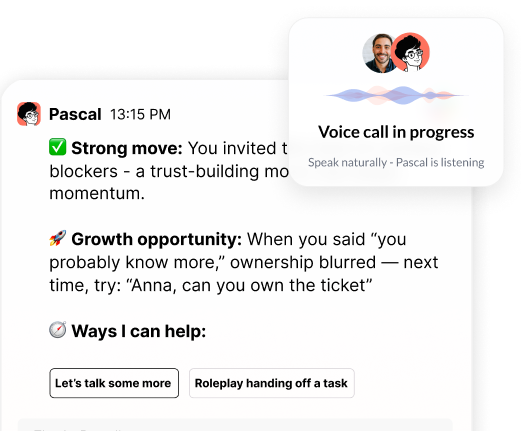
Pascal maintains 94% monthly retention with an average of 2.3 coaching sessions per week through proactive moment-based coaching. Rather than waiting for managers to recognize they need help, Pascal surfaces opportunities for growth based on observed patterns. After a team meeting, Pascal might flag: "Strong move inviting the team to surface blockers. That builds trust. Growth opportunity: When you said 'you probably know more,' ownership blurred. Next time, try: 'Anna, can you own the ticket?'" This proactive approach creates consistent development habits rather than crisis-only support.
Direct Answer: Platforms meeting managers in Slack, Teams, and Zoom eliminate context-switching friction; tools requiring separate logins struggle to move beyond early adopters.
Workflow integration determines whether coaching becomes habit or another abandoned tool. Voice-to-text capabilities enable natural conversation without requiring typed explanations. One tech company saved 150 hours across 50 employees by eliminating tool-switching friction. Pascal lives inside the platforms where managers already work, delivering coaching without requiring new logins or workflows. This integration means coaching happens in the flow of work rather than as a separate activity requiring deliberate context switching.
Direct Answer: Purpose-built platforms include moderation and escalation protocols that recognize when HR involvement is required, protecting organizations while enabling responsible AI adoption.
AI can handle up to 90% of routine coaching, but sensitive topics require human expertise. Effective guardrails include moderation detecting toxic behavior and escalation for terminations, harassment, medical issues, and discrimination concerns. Organization-specific controls allow you to customize which topics trigger escalation based on your risk tolerance.
Platforms without guardrails create legal exposure when managers receive guidance on sensitive issues that should involve HR. Pascal includes multiple protection layers: moderation for harmful content, escalation for sensitive employee topics, and clear HR routing. When conversations touch on harassment, mental health, or terminations, Pascal escalates to HR rather than attempting to provide guidance.
Direct Answer: Vendors ready to scale demonstrate adoption metrics, behavioral change indicators, and business outcomes—not just satisfaction scores or completion rates.
83% of direct reports see measurable manager improvement when using purpose-built AI coaching. Highly engaged users show average 20% lift in Manager Net Promotion Score. Request customer case studies from similar organizations showing adoption rates, manager effectiveness improvements, and team performance gains.
During demos, test specific scenarios mirroring your actual coaching challenges rather than accepting polished presentations. Ask vendors to roleplay a difficult conversation scenario and observe whether they ask clarifying questions, reference organizational context, and provide specific talking points rather than generic frameworks.
| Evaluation Criterion | What to Look For | Red Flag |
|---|---|---|
| Foundational Expertise | Purpose-built for coaching with people science backing | Generic AI tool repurposed for workplace use |
| Contextual Awareness | Integrates HRIS, performance data, meeting transcripts | Requires managers to re-explain situations each time |
| Engagement Model | Proactive coaching with 2+ sessions weekly | Reactive tool with low monthly engagement |
| Workflow Integration | Lives in Slack, Teams, Zoom | Requires separate portal login |
| Sensitive Topic Handling | Clear escalation protocols to HR | No guardrails or escalation processes |
Direct Answer: Vendors ready to scale provide repeatable rollout playbooks, enablement materials, dedicated customer success, and clear integration with existing HR and performance systems rather than requiring custom development.
Organizations lose momentum when pilots extend beyond 1-2 months. Scalable vendors move quickly from pilot to phased rollout to enterprise expansion. The biggest mistake organizations make is extended pilots that lose momentum. Scalable vendors supply manager training, executive briefing decks, communication templates, and industry-specific customer success support.
Integration depth matters: pre-built connectors for HRIS, LMS, performance management, and collaboration tools indicate architectural maturity. Financial stability and product roadmap visibility predict whether the vendor will keep pace with AI innovation during your contract term. Pinnacle brought on three veteran CHROs—Jeff Diana, Shelby Wolpa, and Barb Bidan—as strategic advisors to guide Pascal's development and support HR leaders in adopting AI, demonstrating commitment to understanding enterprise needs.
"We haven't had the people power to provide this level of guidance. Now we finally do and it's scalable." — Melinda Wolfe, Former CHRO, Bloomberg, Pearson, GLG
This sentiment captures why readiness to scale matters. When vendors combine the five foundational capabilities with change management expertise and proven integration patterns, they enable organizations to finally extend coaching access beyond executives to every manager who needs it.
Direct Answer: Generic AI tools, reactive engagement models, separate portal logins, and lack of guardrails for sensitive topics predict adoption failure and organizational risk.
Red flag: Requires managers to re-explain situations (indicates no contextual integration). Red flag: Reactive-only engagement with low monthly usage (predicts underutilization). Red flag: Separate portal requiring login (creates context-switching friction). Red flag: No escalation protocols for sensitive topics (exposes organization to legal risk). Red flag: No guardrails or bias mitigation (violates responsible AI standards).
"Why settle for a subpar add-on when a purpose-built solution is already driving value?" — Melinda Wolfe, Former CHRO, Bloomberg, Pearson, GLG
Organizations evaluating vendors should ask detailed questions about these factors during demos rather than accepting surface-level feature lists. The platforms that deliver measurable impact share common characteristics: they're built specifically for coaching, they understand your organizational context, they meet managers proactively with relevant guidance, they integrate seamlessly into daily work, and they include appropriate safeguards for sensitive topics.
Direct Answer: Move quickly from pilot to phased rollout by prioritizing speed over perfection, providing clear communication about AI coaching's role, and integrating with existing HR processes rather than creating parallel systems.
Scalable vendors supply manager training, executive briefing decks, and communication templates. HR teams that approach AI adoption like product organizations see better results, focusing on employee experience as the primary outcome rather than just technology deployment. Integration depth matters: pre-built connectors for HRIS, LMS, and performance management indicate architectural maturity.
Change management expertise predicts whether vendors can move organizations from pilot to enterprise expansion. Treat AI coaching as a strategic capability requiring thoughtful implementation, not a plug-and-play technology. As Jeff Diana, former CHRO at Atlassian and Calendly, emphasizes, successful AI adoption starts with clear business problems, not the hottest technology. Start where the need is highest and move quickly to prove value before momentum stalls.
Pascal demonstrates all five readiness signals through foundational coaching expertise, deep contextual integration, proactive engagement, seamless workflow embedding, and sophisticated escalation protocols for sensitive topics. Organizations implementing Pascal report 94% monthly retention with managers averaging 2.3 coaching sessions per week, proving that when AI coaching is purpose-built and integrated thoughtfully, adoption becomes natural rather than forced.

.png)
.webp)
“Thank you for setting the great foundation for my promotion; now I have a plan!"

Curious to see how AI Coaching can 10X the impact and scale of your development initiatives. Book a demo today for: