

Democratizing coaching beyond the C-suite delivers measurable ROI by improving manager effectiveness, reducing turnover, accelerating skill development, and scaling impact across the entire workforce at a fraction of traditional costs. The shift transforms coaching from an exclusive executive benefit into an organizational capability that reaches everyone, driven by advances in virtual delivery, AI-powered personalization, and hybrid models that make professional development economically viable at scale.
Quick Takeaway: Democratizing coaching means extending personalized development support beyond senior leaders to every manager and employee through scalable formats like AI coaching, group programs, and hybrid models that reduce cost-per-person from $3,000–$15,000 annually to $30–$150. This shift transforms coaching from a C-suite perk into an organizational capability that reaches everyone, delivering 3–5× ROI within 18 months through faster manager ramp time, improved feedback quality, and measurable behavior change.
The coaching industry has fundamentally shifted. The global coaching market reached US$4.56 billion in annual revenue in 2022, up 60% from 2019, signaling market validation for broader access. More importantly, the infrastructure supporting universal coaching access has matured. Virtual delivery, credentialed coaches, and AI-powered personalization have converged to make scaling coaching beyond executives not just possible but economically sensible.
Democratizing coaching means extending personalized development support beyond senior leaders to every manager and employee through scalable formats like AI coaching, group programs, and hybrid models that reduce cost-per-person from $3,000–$15,000 annually to $30–$150. This shift transforms coaching from a C-suite perk into an organizational capability that reaches everyone. The mechanics have changed fundamentally from how coaching worked five years ago.
72% of coaches now offer virtual options, up from 40% in 2020, enabling cost-effective delivery without geographic or office constraints. This virtualization alone democratized access by eliminating travel costs and scheduling friction that previously limited who could receive coaching. 70% of clients prefer flexible payment structures like tiered programs and group coaching, lowering entry barriers for mid-level employees and individual contributors who previously had zero access.
The economics shift dramatically when you move from one-on-one to group and hybrid models. Group coaching yields $20,000 from 20 clients at $1,000 each for time comparable to one-on-one sessions, enabling coaches to extend their impact while reducing per-person costs. AI coaching extends this further, with 40% of business coaches planning AI investments by 2025 to deliver personalized guidance at scale.
Manager quality directly determines team performance, engagement, and retention. 70% of employee engagement links to manager effectiveness, yet 87% of high-performing organizations actively support new managers compared to just 38% of lower performers. Democratizing coaching closes this gap by ensuring every manager, not just executives, receives consistent development support.
The performance differential is striking. High-performing organizations provide structured support to new managers during transition; lower-performing ones leave managers to figure it out alone. When organizations scale coaching to all managers, direct reports report measurable improvement in manager effectiveness. One implementation saw 83% of colleagues observe visible improvement and a 20% lift in Manager Net Promoter Score.
"If we can finally democratize coaching, make it specific, timely, and integrated into real workflows, we solve one of the most chronic issues in the modern workplace."
The business case is straightforward. 57% of people quit jobs because of bad managers, according to Gallup and DDI research. Each departure costs 50–200% of annual salary to replace. Improving manager quality through scaled coaching directly addresses this cost driver while improving team performance and retention simultaneously.
Coaching at scale addresses the root cause of turnover—poor manager relationships—before employees leave. When every manager receives consistent development support, team engagement improves, reducing voluntary attrition and the 50–200% replacement costs associated with each departure. The math becomes compelling quickly.
AI coaching platforms maintain 94% monthly retention with 2.3 average sessions per week, indicating sustained engagement that drives habit formation and behavior change. Organizations using purpose-built coaching report faster manager ramp time, reducing the productivity loss during the first 6–12 months when new managers are learning. Hybrid models combining AI coaching for daily skill development with quarterly human coach interventions for complex situations deliver measurable team engagement improvements.
The retention impact cascades. Better managers create stronger teams. Stronger teams have higher engagement and lower turnover. Lower turnover reduces replacement costs and preserves institutional knowledge. The compounding effect appears within 18 months as the organization stabilizes around improved manager quality.
Expanding coaching beyond managers to individual contributors accelerates skill development, increases internal mobility, and reduces external hiring costs. Organizations that democratize coaching see faster competency acquisition and higher retention of high performers. Research shows that AI coaching can deliver up to 90% of day-to-day coaching functions, making scalable support to all levels economically viable.
LinkedIn's 2025 Workplace Learning Report positions coaching as a career-development tool for all levels, not just leadership. Purpose-built AI coaching platforms report 25–35% faster training completion and 60% reduction in time to competency when integrated into workflows. One tech company using AI coaching for 50 employees estimated saving 150 hours in the initial rollout through automated feedback collection and reduced HR escalations.
The internal mobility impact matters strategically. When employees receive coaching on developing new skills, they're more likely to move into adjacent roles rather than seeking external opportunities. This reduces external hiring costs while building deeper organizational capability. Employees see clearer career paths, improving retention of high performers who might otherwise leave for advancement opportunities elsewhere.
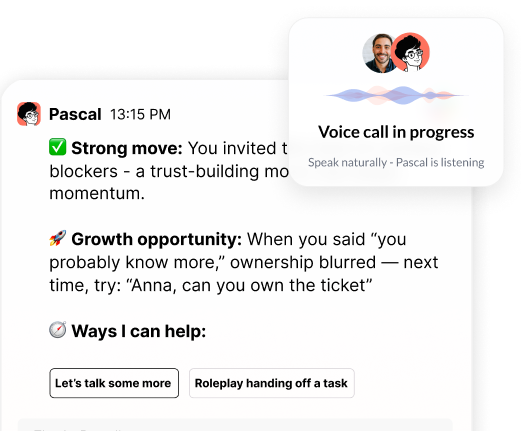
AI coaching reduces per-person cost to 1–2% of human coaching while delivering comparable outcomes for foundational skill development, proactive engagement, and behavioral habit formation. This economics shift makes organization-wide coaching affordable. Pascal integrates with HRIS, performance data, and communication tools to deliver contextual guidance that generic chatbots cannot.
AI coaching handles 90% of day-to-day coaching functions, with human coaches reserved for complex, emotionally charged situations. Hybrid models—AI for daily skill practice and proactive engagement, humans for transformational work—deliver stronger outcomes than either approach alone. Organizations report that embedding AI coaches in Slack, Teams, and meeting platforms eliminates adoption friction because coaching meets managers where they already work.
The cost structure enables scale that was previously impossible. Traditional coaching at $10,000 per manager annually means only 5–10% of your management population receives support. AI coaching at $100–150 per manager annually means you can extend support to 100% of your organization. That democratization of access is the fundamental shift.
Measurable outcomes include faster manager ramp time (30–40% reduction), improved feedback quality and review consistency, higher team engagement scores, reduced voluntary turnover, and ROI of 3–5× within 18 months when coaching scales across the workforce. These outcomes tie directly to business metrics that CFOs and boards care about.
"Real learning and value come from in-context coaching—solving problems in the moment, not in a classroom."
Organizations that democratize coaching through AI see adoption rates above 85% when platforms integrate seamlessly into daily workflows. At HubSpot, 98% of employees used AI tools on the job after implementing proactive systems, with 84% feeling comfortable doing so. The hybrid model (AI + human coaching) delivers better outcomes than either approach alone, with research showing 51% of employees prefer this combination.
Democratization also creates organizational pattern visibility—aggregated, anonymized coaching data reveals systemic issues before they escalate. When multiple managers in the same department discuss similar challenges, that pattern signals a need for systemic intervention rather than individual coaching. This shifts HR from reactive problem-solving to proactive organizational design.
Key Insight: The organizations seeing the strongest ROI from democratized coaching are those treating it as a system, not a tool. They integrate coaching with career development, performance management, and organizational design to create compounding impact.
The business case starts with current state analysis. Measure manager effectiveness using 360 feedback, engagement surveys, and team performance metrics. Quantify turnover costs by calculating the fully loaded replacement cost for each departure. Document the gap between high-performing and lower-performing organizations in manager development support.
Melinda Wolfe, former CHRO at Bloomberg and Pearson, emphasizes making the business case through survey data, internal feedback, and performance trends. Everyone knows manager effectiveness matters. Your job is proving it's also a priority by quantifying the cost of doing nothing.
The financial model compares scenarios. Scenario A: Continue current approach (limited coaching for executives, hoping managers figure it out). Scenario B: Implement democratized coaching at scale. Calculate the cost difference and map it against expected improvements in retention, manager effectiveness, and team performance. Most organizations find the ROI case compelling within 18 months.
Implementation speed matters strategically. Jeff Diana advises moving quickly on pilots rather than waiting for perfect clarity. The organizations capturing value fastest are those that identify a specific use case (new manager support, performance review preparation, difficult conversation coaching), pilot with willing participants, measure leading indicators (adoption, engagement), and expand based on demonstrated results.
Ready to see how purpose-built AI coaching democratizes development across your organization? Book a demo to explore how Pascal delivers contextual, proactive coaching directly in Slack and Teams, providing every manager with the support they need—not just executives. Discover how to scale manager effectiveness and prove ROI through measurable behavior change and business outcomes.

.png)
.webp)
“Thank you for setting the great foundation for my promotion; now I have a plan!"

Curious to see how AI Coaching can 10X the impact and scale of your development initiatives. Book a demo today for: