

Embedded AI tools integrate general-purpose AI capabilities like ChatGPT directly into existing workflows for convenience but lack coaching depth and organizational context, while purpose-built AI coaches combine specialized expertise, contextual awareness, and proactive engagement to drive measurable behavior change and sustained adoption. The architectural choice determines whether managers actually use the tool and whether guidance translates into real results.
Quick Takeaway: Embedded AI tools prioritize frictionless deployment through standard APIs but lack coaching methodology and organizational context. Purpose-built AI coaches integrate deep behavioral science expertise, real workplace data, and proactive engagement to deliver personalized guidance that managers actually trust and apply. The architectural difference directly predicts adoption rates, sustained usage, and measurable improvements in manager effectiveness.
At Pinnacle, we've spent two years building Pascal and working with hundreds of organizations navigating this exact decision. We've learned that the gap between a generic chatbot and a coaching system that drives measurable behavior change isn't just about sophistication. It's about understanding what makes coaching work, how people develop new habits, and where AI assistance crosses into territory requiring human judgment.
Embedded AI tools integrate general-purpose AI capabilities like ChatGPT APIs directly into existing platforms through standard integrations, prioritizing convenience and quick deployment over coaching methodology and organizational context. They live where managers already work—Slack, Teams, HRIS platforms—eliminating the friction of separate logins or new applications.
The architecture is modular and plug-and-play. A manager can ask questions in Slack without opening a separate tool. Implementation happens quickly because vendors provide pre-built integrations and ready-made models. The barrier to entry is low, and initial results can feel impressive.
The limitation is foundational. Embedded tools lack coaching methodology because they're built on general-purpose language models trained on internet-scale data, not on decades of behavioral science, leadership frameworks, or proven coaching principles. Without coaching expertise embedded in the system, managers receive generic frameworks rather than contextual guidance tailored to their specific team dynamics. Research shows that AI coaching increases course completion rates by 57% and reduces time to completion by 60% when systems deliver contextually relevant content rather than generic training modules.
However, this convenience comes at a cost. Engagement drops to 10-20% within six months as managers realize guidance lacks relevance to their specific challenges. The tool that felt helpful during launch becomes just another notification managers learn to ignore.
Purpose-built AI coaches are engineered specifically for coaching with proprietary frameworks grounded in behavioral science, deep integration with company systems, and proactive engagement mechanisms designed to surface coaching opportunities before managers recognize they need help. The architecture includes multiple specialized subsystems: behavioral analysis, contextual reasoning, escalation protocols, and continuous memory across all coaching interactions.
Pascal exemplifies this approach through integration with HRIS, performance reviews, 360 feedback, and organizational culture documentation. The system doesn't just respond to questions. It observes actual team dynamics through meeting integration, recognizes patterns across coaching interactions, and maintains comprehensive memory that informs every guidance moment.
Purpose-built systems maintain 94% monthly retention with an average of 2.3 coaching sessions per week, reflecting sustained relevance rather than initial novelty. This engagement pattern emerges because the coaching becomes increasingly relevant as the system learns organizational context and individual development priorities. Managers return because the advice actually applies to their situations.
Embedded tools achieve faster initial adoption due to workflow integration but see declining usage as managers realize guidance lacks context. Purpose-built coaches maintain sustained engagement through relevance and proactivity that compounds over time.
83% of direct reports see measurable improvement in their managers using purpose-built platforms, with highly engaged users showing a 20% lift in Manager Net Promoter Score. This behavioral improvement translates directly to business outcomes that neither tool category achieves independently. Managers develop new skills 40% faster with proactive coaching because the coaching arrives at maximum relevance when context is fresh and motivation is high.
The engagement patterns reveal the architectural difference clearly. Organizations deploying embedded tools see initial enthusiasm followed by predictable decline. Managers try the system, find the advice too generic to apply, and gradually stop engaging. Purpose-built platforms see the opposite: usage increases over time as contextual awareness improves and coaching becomes increasingly relevant to actual challenges.
Embedded tools access limited organizational data through standard APIs; purpose-built systems synthesize performance reviews, team feedback, meeting dynamics, and culture documentation to understand individual, relational, and organizational context simultaneously. This contextual foundation eliminates the friction that kills adoption.
Embedded limitations are structural. Basic role and employee data only; managers repeat context in every conversation. Purpose-built depth means the system knows employee communication style, career goals, recent feedback, team dynamics, and company competencies. When asked about delegation, embedded AI offers generic frameworks. Pascal knows which team members are ready for stretch assignments based on performance history and aspirations, observes actual meeting dynamics to understand communication patterns, and tailors guidance to your company's specific approach to autonomy and accountability.
Context elimination kills adoption: managers abandon tools requiring them to re-explain team dynamics and organizational realities. Purpose-built systems solve this through architectural integration that makes context feel automatic rather than burdensome.
Embedded tools operate reactively, waiting for managers to ask questions. Purpose-built coaches proactively surface coaching moments after meetings, before difficult conversations, and when patterns suggest intervention. This distinction determines whether coaching creates consistent habits or remains episodic.
Reactive limitation: Managers don't always know what they don't know; coaching arrives too late. Proactive advantage: Real-time feedback after meetings, daily/weekly check-ins, pattern recognition across conversations. Habit formation requires consistent nudges at maximum relevance—when context is fresh and motivation is high.
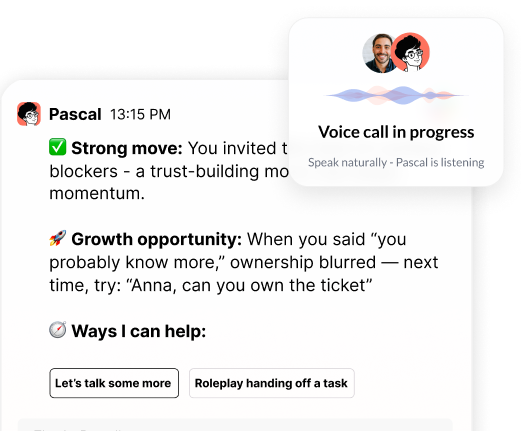
Pascal joins Slack, Teams, Zoom, and Google Meet to deliver guidance without context-switching. After a challenging team meeting, Pascal proactively surfaces feedback in the same Slack thread where the team communicates. When preparing for a one-on-one, Pascal offers relevant guidance directly in Teams. This integration eliminates the context-switching that kills adoption of separate coaching platforms.
Embedded tools suit organizations prioritizing rapid deployment and workflow convenience for tactical questions. Purpose-built coaches deliver ROI for organizations focused on measurable manager effectiveness, sustained behavior change, and scaling coaching access across their entire management population.
Embedded solutions work for supplementing existing programs with convenient access to general management advice. Purpose-built platforms justify their investment through faster manager ramp time, improved feedback quality, and team performance improvements that compound over time. The strategic question isn't which architecture is superior in the abstract. It's which capabilities your organization needs to achieve specific outcomes.
| Factor | Embedded AI Tools | Purpose-Built AI Coaches |
|---|---|---|
| Coaching expertise | General-purpose AI, no coaching training | Proprietary frameworks, behavioral science foundation |
| Contextual depth | Limited to available API data | Comprehensive individual and organizational context |
| Proactive engagement | Reactive only, user must initiate | Continuous coaching opportunities surfaced automatically |
| Adoption friction | Zero friction, lives in existing tools | Integrated into workflow, minimal friction |
| Monthly retention | Declines after initial launch | 94% sustained engagement |
| Sensitive topic handling | No guardrails or escalation | Sophisticated escalation protocols |
The strongest solutions combine purpose-built coaching expertise with embedded delivery, placing sophisticated coaching intelligence directly into the tools managers already use. This eliminates adoption friction while maintaining coaching depth that generic tools cannot provide.
Managers access 50+ proven leadership frameworks and ICF-certified coaching principles without leaving their workflow. Contextual awareness from performance data, team dynamics, and organizational culture informs every interaction. Proactive coaching surfaces opportunities after meetings while embedding eliminates friction to engagement. Pascal demonstrates this hybrid approach by combining behavioral science expertise, deep contextual awareness of your people and organization, and seamless integration into Slack and Teams to deliver coaching that managers actually trust and use consistently.
"Embedded AI tools prioritize frictionless deployment through standard APIs but lack coaching methodology and organizational context. Purpose-built AI coaches integrate deep behavioral science expertise, real workplace data, and proactive engagement to deliver personalized guidance that managers actually trust and apply."
This hybrid model solves the core tension between depth and adoption. Purpose-built coaching expertise ensures guidance is grounded in people science and customized to your culture. Embedded delivery ensures managers actually use it consistently because it requires zero extra effort. The combination drives both adoption rates and behavioral outcomes that neither approach achieves independently.
Key Insight: The future of AI coaching isn't choosing between purpose-built and embedded. It's combining purpose-built expertise with embedded delivery to scale coaching that actually works, delivered where managers already spend their time.
When evaluating AI coaching solutions, ask vendors specific questions that reveal their architectural approach. Does your system have purpose-built coaching expertise, or does it use general-purpose AI adapted for coaching? What organizational data does it integrate to personalize guidance? Is the coaching reactive or proactive? Where does coaching actually happen in your workflow?
Vendors at different architectural levels serve different purposes. Understanding where they sit helps you match the solution to your specific requirements rather than discovering limitations after implementation. The most successful implementations combine purpose-built coaching intelligence with seamless workflow integration and appropriate escalation to human experts for sensitive topics.
"If we can finally democratize coaching, make it specific, timely, and integrated into real workflows, we solve one of the most chronic issues in the modern workplace."
This vision of democratized coaching requires architectural choices that embedded tools simply cannot support. Purpose-built systems designed specifically for coaching journeys deliver the contextual depth, behavioral science foundation, and organizational customization that makes coaching accessible to every manager rather than just senior leaders.
The organizations winning with AI coaching in 2025 are those treating vendor selection as a strategic decision grounded in architectural understanding. They evaluate not just features but foundations. They ask tough questions about coaching expertise, data integration, escalation protocols, and behavior change methodology. And they pilot thoroughly before rolling out broadly, using leading indicators like engagement frequency and manager confidence alongside lagging indicators like performance improvement and retention.
The difference between embedded and purpose-built architecture determines whether your investment scales manager effectiveness or becomes another underutilized tool. Book a demo to see how Pascal's purpose-built architecture combines behavioral science expertise, deep contextual awareness, and seamless workflow integration to drive measurable manager effectiveness across your organization.

.png)
.webp)
“Thank you for setting the great foundation for my promotion; now I have a plan!"

Curious to see how AI Coaching can 10X the impact and scale of your development initiatives. Book a demo today for: