

When a manager types "How do I fire someone?" into ChatGPT, they get a detailed termination script with talking points. When they ask Pascal, something fundamentally different happens: proper escalation, HR involvement, and coaching grounded in your organization's actual policies and legal obligations.
Quick Takeaway: Generic AI tools provide termination advice without understanding employment law, company policy, or the specific employee's situation, creating legal exposure. Purpose-built AI coaching platforms recognize firing as a sensitive topic requiring HR escalation while helping managers prepare for those conversations responsibly.
The risks are substantial. 64% of US managers rely on AI for termination decisions, often without formal training or understanding of legal implications. When managers copy performance notes into public AI tools, they expose confidential employee information that may be used for model training. 66% of employees don't validate AI output before using it, and 56% have made workplace mistakes based on unvetted AI guidance. No escalation to HR means advice may violate company severance policies, state employment law, or create wrongful termination exposure.
Generic AI tools like ChatGPT provide step-by-step termination scripts without considering documentation requirements, jurisdiction-specific employment law, or protected class status, creating significant legal and reputational risk. The accountability gap becomes dangerous: when outcomes go wrong, who bears responsibility—the manager, the organization, or the AI vendor?
This isn't theoretical. When a manager follows ChatGPT's advice and terminates someone without proper documentation or HR involvement, your organization faces potential wrongful termination claims, discrimination exposure, and discovery of the AI-generated talking points used during the conversation. The employee's legal team will argue that your organization failed to provide adequate oversight of management decisions and relied on generic AI advice rather than employment law expertise.
The data exposure compounds the legal risk. 48% of employees have uploaded company information into public AI tools, often without understanding the privacy implications. Performance concerns, compensation discussions, and sensitive employee details get shared with systems that may use that content to train future models. Your organization's confidential employment situations could inform responses given to other users.
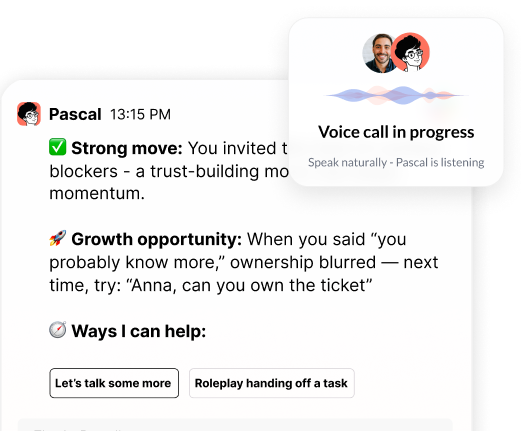
Purpose-built AI coaching platforms recognize termination queries as sensitive topics requiring HR involvement and escalate appropriately while helping managers prepare for those conversations. Pascal identifies when conversations touch employment decisions, medical issues, harassment, or legal matters and politely declines to provide termination talking points but offers to help managers prepare for their HR conversation.
Escalation happens immediately, flagging the situation to the people team with appropriate urgency. Managers still receive support: preparing documentation, framing difficult conversations, thinking through performance history—all within proper guardrails. This protective approach actually increases manager confidence rather than creating frustration. When managers understand that the AI coach knows its limits and will involve appropriate human expertise, they trust the system more.
Consider how this differs from generic tools. A manager asks Pascal about terminating an underperformer. Pascal responds: "This is an important decision that requires your HR partner to ensure we handle it properly. I can help you prepare for that conversation by thinking through your performance documentation, what you've already tried, and what outcomes you're hoping to achieve. Would it help to talk through those elements before you connect with HR?"
The response accomplishes three goals simultaneously. It establishes the boundary clearly. It explains why the boundary exists. It maintains the supportive relationship while appropriately limiting the AI's role.
Generic AI lacks organizational context—your policies, the employee's history, your legal obligations—while purpose-built systems integrate this information to recognize escalation triggers. Pascal accesses performance reviews, documented accommodations, and company policies to understand the full situation.
The platform knows your termination process, required documentation, and HR partner contacts. Without context, AI coaches cannot distinguish between routine feedback conversations and situations with legal implications. A manager in California asking about termination receives fundamentally different guidance than one in at-will employment states, yet ChatGPT provides the same response to both.
This contextual awareness eliminates friction that kills adoption. Managers don't repeat situations; the coach already understands their team dynamics, previous conversations, and documented performance issues. When Pascal helps a manager prepare for an HR conversation about termination, it knows whether that employee is on a performance improvement plan, has disclosed a medical condition, or belongs to a protected class. The guidance reflects specific organizational and legal context, not generic best practices.
Clear escalation protocols ensure human expertise is involved for sensitive topics, creating audit trails and reducing legal exposure while maintaining manager development. The Accountability Dial framework helps managers address performance issues systematically, but termination decisions require HR involvement at every stage.
Moderation systems flag toxic behavior, mental health concerns, and harassment indicators. Data isolation ensures sensitive coaching conversations remain confidential while escalation protocols ensure timely human intervention. Managers gain confidence when they understand the system knows its limits and will involve appropriate human expertise.
Customizable guardrails let you define boundaries matching your company's risk tolerance and culture. Escalation patterns surface to HR teams, enabling proactive intervention before issues escalate. When multiple managers ask about termination in the same week, that pattern might indicate a broader team health issue requiring investigation.
The audit trail created by proper escalation protocols protects your organization in litigation. When a wrongful termination claim arises, you have documented evidence that the manager consulted with HR, followed company policy, and received appropriate coaching on the process. This documentation is far stronger than a ChatGPT conversation history.
Trust emerges when AI coaching platforms have transparent escalation protocols, proper data security, and clear communication about what AI will and won't handle. Organizations need explicit policies defining which topics require human expertise and when escalation happens.
Purpose-built platforms provide moderation that flags concerning content while maintaining employee psychological safety. Managers should understand they're working with AI and know how to request human support. Transparency about capabilities and limitations builds trust and appropriate usage patterns.
Clear escalation messaging maintains the supportive coaching relationship rather than abruptly shutting down conversation. When Pascal recognizes a termination query, it doesn't refuse to help—it redirects toward the right kind of help. This distinction matters enormously for sustained adoption and manager confidence.
Organizations should also communicate that escalation protects managers, not punishes them. A manager who escalates a termination decision to HR is following best practices, not failing. The AI coach reinforces this by positioning HR involvement as the right move, not a limitation.
Managers relying on unrestricted AI for termination advice face legal exposure, bias perpetuation, and erosion of trust when decisions don't align with company policy or employment law. 60% of managers report using AI for team decisions including raises, promotions, and terminations, yet only 1% of organizations have mature AI governance despite 78% using AI in some capacity.
Without proper guardrails, AI coaching can amplify existing biases in performance management and reinforce discriminatory patterns. Shadow AI use—employees secretly using unapproved tools—creates audit and compliance gaps that HR teams can't monitor. When a manager terminates someone based on ChatGPT advice that failed to account for protected status, your organization faces both the original employment claim and evidence of inadequate oversight.
As Melinda Wolfe, former CHRO at Bloomberg and Pearson, emphasizes, "It makes it easier not to make mistakes. And it gives you frameworks to think through problems before you act"—but only when the system includes proper guardrails. Purpose-built platforms provide those guardrails through design rather than hoping managers will use generic tools responsibly.
The legal consequences of poor AI governance compound quickly. Discovery in employment litigation will reveal AI conversations, manager training records, and HR protocols. If those protocols show inadequate oversight of AI use for sensitive decisions, your exposure increases dramatically.
The question isn't whether your managers are already asking AI about sensitive topics. They are. The question is whether they're getting guidance grounded in your company's policies, legal obligations, and people-first values—or generic advice that creates risk.
Book a demo to see how Pascal handles complex workplace scenarios with built-in escalation protocols, contextual awareness, and proper human-AI boundaries. Discover how purpose-built AI coaching scales manager effectiveness while protecting your organization from the risks of unrestricted AI use. Schedule your demo today to explore how Pascal delivers both safety and impact.

.png)
.webp)
“Thank you for setting the great foundation for my promotion; now I have a plan!"

Curious to see how AI Coaching can 10X the impact and scale of your development initiatives. Book a demo today for: