

An AI coach sitting in isolation becomes another underutilized tool. One embedded in the right organizational home—with clear ownership, cross-functional partnership, and aligned accountability—transforms manager effectiveness at scale. The placement question determines whether coaching drives measurable outcomes or becomes expensive shelfware.
Quick Takeaway: Where your AI coaching function sits within your organization determines adoption rates, governance rigor, and whether coaching becomes a core talent lever or a standalone tool. The strongest implementations place ownership in HR/Talent with co-governance from IT and analytics, creating the strategic alignment that drives sustained behavior change and measurable business impact.
Placement refers to which function owns the AI coaching strategy, how it integrates with existing systems, and which leaders share governance responsibility. This decision directly impacts adoption rates, measurement rigor, and whether coaching becomes a core talent lever or a standalone tool.
Strategic ownership determines whether coaching focuses on talent development, performance management, transformation, or a hybrid approach. Cross-functional partnership between HR, IT, analytics, and business units ensures alignment and prevents silos. Clear governance prevents fragmentation across multiple AI tools competing for manager attention. Integration with existing systems like HRIS and performance reviews enables personalization and measurement that justifies continued investment.
The optimal home depends on your primary outcome, but the strongest implementations place ownership in HR/Talent with co-governance from IT and analytics. This structure ensures coaching aligns with talent strategy while maintaining data security and measuring impact against business metrics.
HR/Talent ownership drives strategy around who gets coached, when, and toward what outcomes. This function integrates coaching into onboarding, leadership programs, and succession planning while measuring impact against retention and engagement. IT co-governance ensures data security, compliance, system integration, and scalability without creating bottlenecks. Analytics partnership establishes measurement frameworks linking coaching activity to business outcomes. Business unit involvement matters when coaching supports specific change initiatives where adoption is critical to success.
Avoid isolated ownership. Coaching effectiveness depends on cross-functional alignment that ensures multiple perspectives shape how the organization develops managers.
The CHRO-CTO-CPO "trifecta" balances people strategy, technical execution, and user adoption in ways siloed ownership cannot. This coalition determines both where coaching lives and how it operates effectively across the organization.
The CHRO owns talent strategy and coaching outcomes, ensuring the system reinforces organizational development priorities. The CTO manages data security, integration, and compliance, preventing the technical constraints that kill adoption. The CPO ensures user experience drives adoption through seamless workflow integration rather than requiring managers to adopt new tools.
"The trifecta is the CHRO, the Chief Product Officer, and the CTO—those three together can reshape how an organization operates."
— Gail Fierstein, former Chief People Officer at CaaStle, Goldman Sachs, and Pearson
When these three align, coaching scales effectively; when misaligned, adoption stalls and governance gaps emerge.
Strategic ownership differs from technical residence, and the best implementations separate these concerns thoughtfully. The most successful organizations place ownership in HR/Talent while embedding coaching into collaboration tools where managers already work.
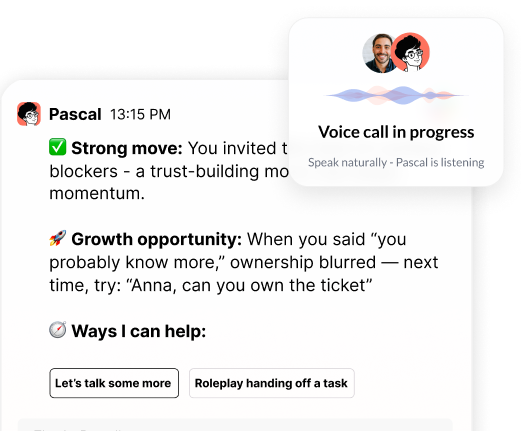
Strategic home is HR/Talent, where coaching strategy aligns with talent development priorities and business outcomes. Technical residence is integrated into communication and meeting platforms where adoption happens naturally. Pascal lives in Slack, Teams, and Zoom while integrating with HRIS and performance systems, eliminating friction while maintaining accountability. Governance structure is co-owned by IT for data protection and analytics for outcome measurement.
This separation of strategic ownership from technical residence eliminates the adoption friction that kills most tools while maintaining clear accountability for outcomes.
AI coaching fails when placed in isolated functions without clear metrics, when ownership is ambiguous, or when it's treated as a technology purchase rather than a strategic talent capability requiring change management.
Extended pilots running 6+ months lose momentum; start with 30–60 day focused tests that generate early wins. Undefined ownership creates accountability gaps; assign clear strategic owner with executive sponsorship from day one. Lack of measurement means no business case for continued investment; track leading indicators like engagement and behavior change. Siloed implementation creates fragmentation; establish cross-functional governance from day one.
The worst mistake is treating AI coaching as a standalone tool rather than as a strategic talent capability. When ownership is unclear, measurement is absent, and integration is minimal, coaching becomes another underutilized platform that drains budget without delivering outcomes.
Choose placement based on your primary business problem and which function has credibility to drive adoption and measure outcomes.
Manager effectiveness or leadership pipeline? Place in HR/Talent or L&D; measure against manager quality metrics and leadership readiness. Performance consistency and outcomes? Co-own with People Analytics; track coaching impact against business KPIs. Transformation at scale? House in Business Unit with HR as partner; create direct accountability for adoption. Enterprise integration and compliance? Partner with IT/Data; establish governance and security frameworks.
Organizations like HubSpot and Zapier embed coaching across employee lifecycles with HR-IT partnership, creating consistent development experiences that drive measurable improvements in manager effectiveness. Pascal lives where managers work—integrated into Slack, Teams, and Zoom—while connecting seamlessly with your HRIS and performance systems. This hybrid placement enables HR ownership with IT governance, ensuring coaching personalizes to your organization while maintaining security and compliance.
Primary Business GoalRecommended OwnershipKey Success MetricsManager effectiveness and developmentHR/Talent with IT partnershipManager NPS, direct report engagement, retentionPerformance consistency and outcomesHR/Talent + People AnalyticsPerformance review quality, business KPIs, behavior changeTransformation at scaleBusiness Unit + HR as partnerAdoption rate, time to competency, transformation outcomesEnterprise integration and securityIT/Data + HR as strategic partnerSystem integration, compliance, data governance
Key Insight: The placement decision isn't technical—it's strategic. Organizations that align ownership with outcomes, establish clear cross-functional partnerships, and embed coaching into daily workflows see adoption rates above 80% and measurable improvements in manager effectiveness within months.
The placement decision isn't about technology features or vendor capabilities. It's about organizational alignment. Organizations that get this right see adoption rates above 80% and measurable improvements in manager effectiveness because they've solved the strategic puzzle of where coaching belongs and who owns it.
Pascal integrates into your existing workflow tools while connecting with your HRIS and performance systems, making it easy to place ownership with HR while ensuring IT and analytics stay connected. The platform's contextual awareness means coaching adapts to each manager's situation, their team's dynamics, and your organization's culture. Book a demo to explore the right placement strategy for your organization and see how Pascal's integration drives the adoption and business outcomes that justify your investment in manager development.

.png)
.webp)
“Thank you for setting the great foundation for my promotion; now I have a plan!"

Curious to see how AI Coaching can 10X the impact and scale of your development initiatives. Book a demo today for: