

An AI coach living in a separate portal that managers must remember to visit will be abandoned within weeks. An AI coach embedded in Slack, Teams, and Zoom—where managers already work—becomes a daily habit. Integration strategy determines whether your investment transforms manager effectiveness or becomes expensive shelfware.
Quick Takeaway: Purpose-built AI coaches integrate with HRIS, performance management systems, communication platforms, and meeting tools to access the organizational context that makes coaching relevant. Without these integrations, AI defaults to generic advice that managers can find anywhere. Adoption rates jump from 10–20% for standalone portals to 65–85% for deeply embedded solutions because integration eliminates friction and enables coaching at teachable moments.
At Pinnacle, we've learned that the most critical factor determining whether an AI coach becomes a trusted daily resource or another underutilized tool is integration depth. When Pascal connects to your actual organizational systems and workflow tools, managers experience coaching that's specific to their situation. When it operates in isolation, even sophisticated AI feels generic and requires managers to repeatedly explain context.
Purpose-built AI coaches integrate with HRIS, performance management systems, communication platforms, and meeting tools to access the organizational context that makes coaching relevant. Without these integrations, AI defaults to generic advice that managers can find anywhere.
HRIS data provides foundational context: roles, reporting structure, tenure, and organizational hierarchy that transforms coaching from generic ("how do you delegate?") into specific ("how do you delegate to Anna, who's been here eight months and is ready for more visibility?"). Performance reviews and 360 feedback ground developmental coaching in actual feedback themes rather than theoretical frameworks. Company documentation—values, competency frameworks, culture manifestos—ensures coaching aligns with organizational expectations rather than generic best practices.
Calendar and meeting access enable observation-based feedback on actual leadership behavior rather than self-reported scenarios. Real-time data syncing ensures coaching reflects current organizational reality without requiring manual updates. Pascal integrates across all these sources to build a proprietary knowledge graph connecting every interaction, insight, and outcome. When a manager asks for help preparing feedback, Pascal already knows the employee's communication preferences, recent project outcomes, and career goals, making guidance immediately applicable.
AI coaches embedded in Slack, Teams, and Zoom see 3–5x higher adoption than standalone portals because they eliminate context-switching friction and enable coaching at teachable moments.
Adoption rates jump from 10–20% for portal-based tools to 65–85% for workflow-embedded platforms. Managers using embedded coaches average 2.3 coaching sessions per week with 94% monthly retention versus less than one session monthly for portal-based tools. Meeting integration allows real-time observation of leadership behavior and immediate feedback when context is fresh. Slack/Teams embedding makes coaching one click away in tools managers check dozens of times daily. Proactive notifications surface coaching opportunities before managers realize they need help, creating consistent development habits rather than crisis-only support.
Organizations like HubSpot achieved 98% employee AI tool usage by embedding AI throughout onboarding and daily workflows. The key isn't the technology—it's meeting people where work happens.
Native integrations with your performance management system, goal-setting platform, and HRIS create the contextual foundation that makes coaching specific to actual people and situations rather than generic scenarios.
Real-time HRIS sync ensures the coach knows current reporting structures, tenure, and role changes. Performance review access provides historical context for developmental coaching. Goal-setting system integration connects coaching to individual aspirations and career plans. 360 feedback data informs personalized coaching on specific strengths and development areas. Calendar integration enables proactive coaching before high-stakes conversations.
Meeting platform integrations (Zoom, Google Meet) enable observation-based coaching that references actual behavior, while communication tool integrations (Slack, Teams) make coaching frictionless and habitual.
Meeting observation identifies leadership patterns managers wouldn't recognize independently. Real-time feedback arrives when context is fresh and implementation is straightforward. Slack/Teams embedding ensures coaching happens in the same interface where work already occurs. Message threading maintains conversation continuity across coaching interactions. Calendar access enables proactive outreach before critical meetings or conversations.
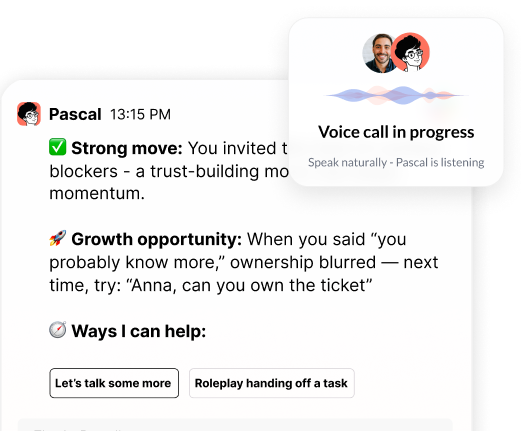
Pascal joins meetings with full transparency and consent, analyzing team dynamics to deliver specific feedback: "You invited the team to surface blockers—a trust-building move. When you said 'you probably know more,' ownership blurred. Next time, try: 'Anna, can you own the ticket?'"
Purpose-built AI coaches include moderation systems that detect sensitive topics and escalate to HR rather than attempting to provide guidance on harassment, medical issues, terminations, or mental health concerns.
Automatic detection of sensitive employee topics triggers HR escalation. Moderation flags toxic behavior, harassment, or mental health concerns. Customizable guardrails let you define which topics the AI won't respond to. Escalation protocols ensure human expertise handles situations requiring legal or ethical judgment. Anonymized trend reporting surfaces organizational patterns for strategic HR attention.
This protective layer isn't optional—it's essential for legal protection and building trust that the AI operates within appropriate boundaries. Pinnacle has completed its most recent SOC 2 examination, confirming that systems are protected against unauthorized access, remain reliably available, and safeguard confidential information.
Key Insight: The best coaching happens at the moment of need. Deep integration ensures managers receive guidance when they're actually making decisions, not hours later when they remember to check a separate platform.
Ask vendors which systems they connect to natively versus through manual data export, how frequently data syncs, whether the platform requires separate logins, and what guardrails protect sensitive topics. Integration depth determines adoption more than feature sophistication.
Request specific examples of how integrations inform coaching in real scenarios. Assess whether setup requires IT involvement or can launch in days. Verify whether the coach lives in existing tools or requires managers to adopt a new platform. Confirm data security protocols and compliance certifications (SOC2, GDPR). Evaluate how the platform handles escalation for sensitive workplace topics.
The organizations that see the highest ROI from AI coaching are those that prioritize deep integration, company-specific data access, and privacy-conscious design. They measure adoption as product-market fit: when coaching integrates into daily workflow rather than requiring separate logins, engagement stays high.
Integration depth creates measurable competitive advantages that compound over time. When Pascal lives where work happens, managers maintain 94% monthly retention with an average of 2.3 coaching sessions per week. Organizations see 83% of colleagues report measurable improvement in their manager's effectiveness. Manager Net Promoter Score increases by an average of 20% among highly engaged users.
These outcomes reflect what happens when integration eliminates friction. Managers don't need to remember to seek coaching. They don't need to explain context repeatedly. They don't need to translate generic advice into their specific situation. The coaching arrives contextually aware, proactively offered, and immediately applicable.
"If we can finally democratize coaching, make it specific, timely, and integrated into real workflows, we solve one of the most chronic issues in the modern workplace."
Pinnacle raises $2.5M to make AI coaching available to all demonstrates how deep integration powers personalization at scale. The organizations that see the highest ROI from AI coaching are those that prioritize deep integration, company-specific data access, and privacy-conscious design.
AI coaching: The future of leadership development is here explains how the future of work involves humans and AI collaborating, not competing. Getting that collaboration right starts with giving managers the contextual support they need to focus on the parts of leadership only humans can do well. Organizations that implement generic coaching tools find themselves supporting two systems: the AI that provides basic information and the human coaches who handle everything important. That defeats the purpose.
Purpose-built coaching systems grounded in people science provide guidance that managers actually trust and apply, while contextual awareness that is truly embedded in your workflow eliminates the friction of repeatedly explaining situations, leading to sustained engagement. The strategic question for CHROs isn't whether to implement AI coaching. 78% of companies globally already use AI in daily operations, and that percentage will only grow. The question is whether your coaching platform will drive measurable manager effectiveness or become another underutilized SaaS product.
Context makes the difference. Organizations that prioritize deep integration, company-specific data access, and privacy-conscious design will see the completion rates, satisfaction scores, and behavior change that justify investment. Those that settle for generic platforms will see another initiative lose momentum as employees quietly return to old habits.

.png)
.webp)
“Thank you for setting the great foundation for my promotion; now I have a plan!"

Curious to see how AI Coaching can 10X the impact and scale of your development initiatives. Book a demo today for: