

Real-world AI coaching implementations are proving that contextual guidance drives measurable improvements in manager decision-making and team engagement. Organizations like HubSpot, Zapier, Marriott, and Verkada report that managers using purpose-built AI coaching show 83% observable improvement from direct reports, with 20% average lifts in Manager Net Promoter Score among highly engaged users. These outcomes stem not from generic AI tools, but from platforms that understand organizational context, integrate into daily workflows, and provide proactive support at the moments managers need it most.
Quick Takeaway: Organizations that deploy contextually aware, proactive AI coaching integrated into daily workflows see sustained adoption and measurable behavior change. Success depends on purpose-built coaching expertise, contextual awareness of your people and culture, proactive engagement rather than reactive responses, seamless workflow integration, and appropriate guardrails for sensitive topics. These five factors determine whether AI coaching becomes transformative or decorative.
Real-world implementations show managers make better decisions when AI coaching provides immediate, contextual guidance tailored to their specific team and situation. Contextual awareness eliminates friction, proactive engagement creates consistent habits, and workflow integration ensures adoption.
HubSpot's approach demonstrates that embedding AI into the employee lifecycle drives measurable adoption. The company introduced AI tools within new hires' first two days and normalized usage through weekly demonstrations. By mid-2025, 98% of employees used AI tools on the job and 84% felt comfortable doing so. This cultural integration meant managers viewed AI as a capability enabler, not a threat.
Zapier embedded AI fluency directly into hiring, onboarding, and performance reviews, making coaching part of how people work rather than optional. The structural integration created accountability and capability development simultaneously. Marriott scaled AI coaching across 400,000+ employees by embedding guidance in mobile-first learning hubs, delivering personalized micro-lessons where frontline associates actually work, not requiring them to visit desktop platforms.
Contextual awareness drives the difference: When a manager asks for help preparing feedback for a specific team member, purpose-built AI coaches like Pascal already know that employee's communication style, recent projects, performance history, and career goals. Generic AI tools offer templates that may not fit the relationship or situation.
Proactive coaching achieves 75% regular usage versus 51% for on-demand tools because it eliminates friction, delivers guidance at moments of maximum relevance, and creates consistent habit loops that drive sustained behavior change. Research consistently shows proactive approaches achieve 25% to 53% higher engagement than on-demand models.
94% monthly retention with an average of 2.3 coaching sessions per week for proactive systems indicates habit formation rather than crisis-only support. On-demand tools see engagement drop to 20-30% monthly retention because friction compounds at each decision point.
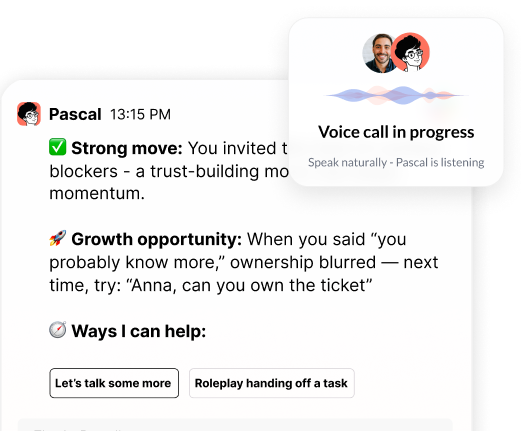
Proactive systems surface coaching opportunities after meetings, before difficult conversations, and when behavioral patterns suggest a development need—not waiting for managers to recognize they need help and seek it out. Pascal joins meetings to observe team dynamics and delivers real-time feedback immediately after interactions, when context is fresh and the coaching moment is most actionable. A manager receives specific guidance within minutes of a one-on-one conversation rather than days later when the learning opportunity has faded.
The time-saving advantage compounds quickly. A tech company with 50 employees estimated saving 150 hours in the first month through reduced escalations to HR and faster performance review preparation.
Organizations report 83% of direct reports see measurable improvement in their manager's effectiveness, with highly engaged users showing a 20% increase in Manager Net Promoter Score. These outcomes stem from consistent coaching that creates habit loops and sustained behavior change.
Manager effectiveness improvements show up in specific behaviors: more frequent feedback, clearer delegation, more developmental one-on-ones, and higher-quality performance reviews. Adoption metrics predict success better than vanity metrics: monthly retention (should be 80%+), sessions per week (should be 2+), and colleague-reported improvement matter more than total signups.
Colleague-reported improvement represents the most meaningful measure. When 83% of colleagues notice observable improvements in their manager, that reflects actual behavior change, not just platform engagement. This metric captures what CHROs ultimately care about: does this investment drive manager effectiveness that teams experience directly?
| Outcome Category | Metric | Real-World Result |
|---|---|---|
| Manager Effectiveness | Direct reports seeing improvement | 83% |
| Manager Perception | Manager Net Promoter Score lift | +20% (highly engaged users) |
| User Retention | Monthly retention rate | 94% |
| Engagement Frequency | Avg. coaching sessions per week | 2.3 |
| Time Savings | Hours saved (50-person rollout, month 1) | 150 hours |
Success depends on five critical factors: purpose-built coaching expertise grounded in people science, contextual awareness of your people and culture, proactive engagement rather than reactive responses, seamless workflow integration, and appropriate guardrails for sensitive topics.
Generic AI tools like ChatGPT provide broad answers but lack workplace context, coaching methodology, and understanding of organizational culture. They fail when they offer irrelevant advice or confidently provide guidance on sensitive topics (terminations, harassment, medical issues) that require human judgment. Contextual awareness eliminates the friction that kills adoption in on-demand models.
Verkada and Bercatta made Pascal mandatory for engineering managers seeking promotion, embedding AI coaching data directly into leadership advancement decisions. This structural integration forced rigor into how the company assesses whether managers are ready for greater responsibility.
Workflow integration determines adoption more than feature sophistication: Pascal lives in Slack, Teams, Zoom, and Google Meet because that's where managers already work. Tools requiring separate logins face dramatic adoption challenges.
Guardrails matter: Purpose-built platforms recognize when situations require human expertise and escalate appropriately (harassment claims, medical issues, terminations), protecting both employees and organizations from well-intentioned but potentially problematic manager responses.
AI coaching extends high-quality guidance to every manager at 1/20th to 1/100th the cost of human coaching, creating the ability to reach 20 to 100 times more employees. Proactive integration into daily workflows ensures adoption doesn't depend on manager initiative or self-awareness.
HubSpot's hybrid approach combines AI coaching for routine daily guidance with human coaches for strategic development, freeing human expertise to focus on high-value interventions rather than routine questions.
"If we can finally democratize coaching, make it specific, timely, and integrated into real workflows, we solve one of the most chronic issues in the modern workplace."
Organizations achieve faster manager ramp time (40% acceleration in some cases), higher quality feedback conversations, and improved performance review consistency—the exact outcomes CHROs need to justify HR investments. When managers receive coaching in the moments they actually need it—preparing for a tough 1:1 or in the middle of team conflict—they apply the guidance immediately, rather than trying to recall training from months ago.
Organizations seeing strongest outcomes prioritize contextual awareness, proactive engagement, and workflow integration. Those are the factors that determine whether AI coaching becomes transformative or decorative.
Managers who engage with AI coaching 2-3 times weekly develop new patterns through repetition and reinforcement that one-time training events cannot match. Proactive coaching surfaces opportunities before managers realize they need help, creating consistent development habits. Meeting integration provides coaching at maximum relevance when context is fresh and motivation to improve is highest.
Escalation protocols ensure sensitive topics reach human expertise while routine coaching remains accessible 24/7. Aggregated, anonymized insights surface organizational patterns that individual managers miss, enabling HR to intervene early. Jeff Diana, former CHRO at Atlassian and Calendly, emphasizes that speed in decision-making and learning is now a competitive advantage, requiring leaders to integrate learning with daily work rather than separate training programs.
"So much of the real learning and value that comes from this comes from in-context coaching in the moment to drive performance and to solve problems in the moment."
The organizations getting the most value from AI coaching think beyond the first quarter, building capabilities that will matter as AI becomes woven into how work gets done. Rather than choosing between being directive or collaborative, managers can use AI to understand when each approach fits best based on specific situations and team member needs.
The real-world cases are clear: organizations that deploy contextually aware, proactive AI coaching integrated into daily workflows see sustained adoption and measurable behavior change. Pascal combines purpose-built coaching expertise with deep organizational context to deliver guidance managers actually trust and apply. Book a demo to explore how Pascal's meeting integration, proactive feedback, and escalation protocols drive the consistent habit formation and measurable improvements your organization needs.

.png)
.webp)
“Thank you for setting the great foundation for my promotion; now I have a plan!"

Curious to see how AI Coaching can 10X the impact and scale of your development initiatives. Book a demo today for: