
The most effective AI coaching systems integrate individual employee data, organizational context, and real-time work information to deliver personalized guidance that managers actually apply. Rather than relying on generic frameworks, these platforms synthesize performance reviews, career goals, 360 feedback, communication patterns, and company values into coaching that reflects your specific culture and people. The difference between systems that drive measurable behavior change and those that gather dust comes down to what data they access and how thoughtfully they use it.
Quick Takeaway: Effective AI coaching systems leverage three layers of data—individual employee information, organizational knowledge, and real-time work context—to eliminate the friction that kills adoption. When managers don't need to repeatedly explain their situation, coaching becomes a trusted daily resource rather than another platform to remember.
In our work implementing AI coaching across organizations ranging from 100 to 5,000 employees, we've observed a clear pattern. Platforms that access and synthesize company data drive sustained engagement and measurable outcomes. Those that operate in isolation from your organization's reality become expensive experiments that managers try once and abandon. The question for CHROs isn't whether AI coaching can work. It's whether your chosen platform has the contextual awareness to make guidance relevant enough that managers apply it immediately.
Effective AI coaching systems access performance reviews, career goals, 360 feedback, and communication patterns to understand each person's development needs, not just their job title. This individual-level context eliminates the exhausting need to repeatedly explain background information before receiving useful guidance.
Performance review history shows where someone has struggled and improved over time, revealing patterns that generic AI tools completely miss. Career aspirations from goal-setting conversations reveal what development matters most to them personally, allowing coaching to connect skill-building to individual motivation. 360 feedback synthesizes peer and direct report perspectives on specific behaviors and impact, providing the unvarnished truth that self-reported preferences cannot capture. Communication patterns from meeting transcripts and Slack interactions reveal actual working style, not preferences people claim to have.
Pascal, Pinnacle's AI coach, integrates all these sources into what we call a proprietary knowledge graph. When a manager asks for help delegating, Pascal doesn't offer generic frameworks. Pascal knows whether this manager tends to over-explain tasks, which team members are ready for stretch assignments, and current project pressures that might be creating bottlenecks. The guidance becomes immediately actionable because it's grounded in observable behavior and real team dynamics.
This individual-level context eliminates the friction that kills adoption. Research shows that 56% of coaches now use AI tools for real-time goal-setting and progress tracking, and the platforms driving highest engagement are those where users don't need to provide extensive background information before receiving relevant guidance. Managers return to Pascal because the coaching addresses their actual challenges, not hypothetical scenarios.
Company values, competency frameworks, culture documentation, and leadership principles ensure coaching aligns with how success is defined in your specific environment, not generic best practices. This organizational layer matters more than most realize because it determines whether managers apply the guidance or dismiss it as irrelevant to their culture.
A feedback approach that works brilliantly at a fast-moving startup might fail spectacularly at a regulated financial services firm. Pascal addresses this by ingesting your organization's documented values, competency frameworks, leadership principles, and culture documentation. The result is coaching that reinforces your shared language rather than introducing conflicting approaches.
This cultural alignment matters more than many CHROs initially recognize. When coaching guidance conflicts with organizational norms, managers face an impossible choice: follow the AI's advice and violate cultural expectations, or ignore the tool entirely. Most choose the latter, which is why recent research shows that 57% of professional coaches believe AI cannot deliver real coaching when divorced from organizational context. The skepticism reflects experience with generic tools that provide theoretically sound but organizationally misaligned advice.
When Pascal knows your company's specific approach to feedback, your values around transparency, and your competency frameworks, the guidance reinforces what your organization already believes matters. A manager preparing for a performance conversation receives talking points that sound natural within your culture because they're grounded in your actual leadership expectations, not someone else's best practices.
Meeting transcripts, calendar patterns, and team interaction data allow AI coaches to surface coaching moments before managers realize they need help, creating consistent development habits rather than crisis-only support. This real-time awareness transforms coaching from reactive to proactive.
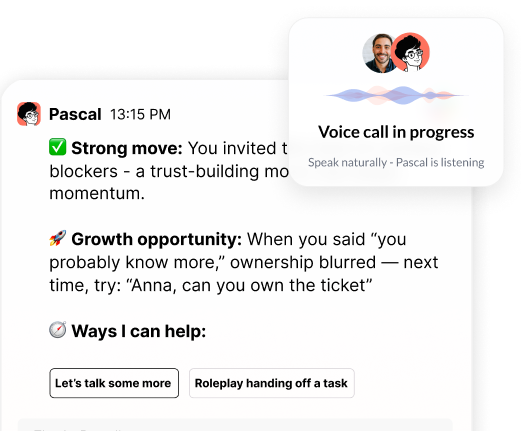
The most sophisticated data integration happens when AI coaches observe actual work. Pascal joins meetings through Zoom and Google Meet integrations to analyze team dynamics in real time. This isn't surveillance. It's contextual awareness that enables proactive coaching. After a team meeting where a manager unintentionally blurred ownership by deferring to team expertise, Pascal flags the moment and suggests clearer language. The feedback arrives when context is fresh and implementation is straightforward.
Organizations using AI-powered training with company-specific data report 57% higher course completion rates, 60% shorter completion times, and 68% higher satisfaction scores. These metrics reflect the engagement that happens when coaching addresses actual situations rather than hypothetical scenarios. When Pascal helps a manager prepare a performance review, it references that specific employee's past performance, recent project challenges, and career goals. The guidance isn't templated. It's specific to that relationship.
Proactive coaching creates the consistent touchpoints that drive sustained behavior change. Rather than waiting for managers to recognize they need help and take action to get it, Pascal surfaces opportunities as they happen. This approach generates the 2.3 coaching sessions per week and 94% monthly retention we observe with highly engaged users, far exceeding typical engagement rates for reactive tools.
Effective platforms isolate data at the user level, maintain explicit consent protocols, and include escalation procedures for sensitive topics, ensuring contextual coaching doesn't create surveillance concerns. Privacy architecture determines whether employees feel supported or monitored.
The power of contextual coaching creates legitimate privacy concerns. Pascal addresses this through architectural design. All data is encrypted and stored at the individual user level, making cross-account leakage technically impossible. Coaching conversations remain confidential unless the user explicitly shares insights. Most importantly, customer data never trains underlying AI models.
Transparency matters equally. Employees should understand what data informs their coaching and have control over their information. When employees see immediate personal benefit from contextual coaching and understand privacy protections, adoption follows naturally. By 2027, at least one global company is predicted to face an AI deployment ban due to data protection non-compliance, making robust privacy architecture a business-critical requirement, not a nice-to-have feature.
Pascal's approach includes several key protections. All data is encrypted and stored at the individual user level, making cross-user leakage technically impossible. Conversations remain confidential unless the user explicitly chooses to share them. The platform never trains AI models on customer data. When conversations touch sensitive topics like harassment, medical issues, or terminations, Pascal escalates to HR rather than attempting to provide guidance.
Performance data, goal information, team structure, and communication patterns deliver the highest ROI because they enable coaching on actual challenges managers face daily, not abstract scenarios. The most impactful data sources fall into specific categories that directly correlate with behavior change.
Organizations using contextual AI coaching report 34% time savings (45 hours per month) per employee and measurable improvements in manager effectiveness. These outcomes flow directly from coaching grounded in real data. When Pascal helps a manager prepare a performance review, it references that specific employee's past performance, recent project challenges, and career goals. The guidance isn't templated. It's specific to that relationship.
| Data Source | Coaching Value | Business Impact |
|---|---|---|
| Performance reviews and goals | Personalizes feedback and development planning | Faster ramp time for new managers |
| Team structure and dynamics | Enables team-specific guidance | Higher quality feedback conversations |
| Company values and competencies | Aligns coaching with organizational culture | Sustained behavior change and adoption |
| Meeting transcripts and communication patterns | Identifies real-time coaching opportunities | Proactive development before problems escalate |
These data sources work together to create the contextual depth that makes coaching actionable. When isolated, any single source provides only partial insight. Synthesized together, they enable guidance that managers recognize as relevant to their specific situation and immediately apply.
Choose platforms that integrate with your HRIS, performance management systems, and communication tools; demonstrate purpose-built coaching expertise; and include escalation protocols for sensitive topics. The vendor selection criteria directly predict implementation success.
Ask potential vendors: What company data does your system access? How does it protect confidentiality? What happens when the AI encounters sensitive topics like harassment or mental health concerns? Can you demonstrate measurable behavior change, not just usage metrics?
Three veteran CHROs recently joined Pinnacle as strategic advisors specifically because they recognized that purpose-built platforms with proper context, guardrails, and organizational alignment deliver measurably better outcomes than generic tools. The vendors that succeed long-term balance contextual depth with robust privacy safeguards and appropriate escalation to human expertise.
The most critical distinction separates platforms that leverage your company's specific data to deliver personalized guidance from those that provide generic advice to every user. Pinnacle's recent funding announcement highlighted how investors recognize the competitive advantage that comes from purpose-built coaching systems grounded in proprietary data and frameworks.
Organizations implementing contextual AI coaching see the strongest outcomes when they prioritize data integration, privacy safeguards, and cultural alignment during vendor selection. The platforms that combine these elements drive adoption rates above 90% and measurable improvements in manager effectiveness that justify continued investment.
Ready to see how contextual AI coaching actually works? Book a demo with Pascal to explore how purpose-built AI coaching leverages your organizational data to deliver personalized guidance that drives measurable manager effectiveness improvements.

.png)
.webp)
“Thank you for setting the great foundation for my promotion; now I have a plan!"

Curious to see how AI Coaching can 10X the impact and scale of your development initiatives. Book a demo today for: