

AI coaching delivers measurable manager effectiveness improvements where traditional training fails by combining real-time guidance, contextual personalization, and continuous reinforcement at the moment managers actually need support. Unlike scheduled workshops or self-paced modules, purpose-built AI coaching platforms integrate into daily workflows, observe actual team interactions, and adapt guidance to individual situations and organizational culture, creating sustained behavior change rather than forgotten content. Research shows that employees forget 90% of traditional training content within a week, yet AI coaching achieves effect sizes nearly identical to human coaching (AI: ηρ² = .269; human: ηρ² = .265) through spaced repetition, contextual relevance, and 24/7 availability.
Quick Takeaway: Purpose-built AI coaching platforms outperform traditional training and generic LMS content by delivering personalized guidance in the flow of work where managers face real challenges. The five critical factors that separate effective AI coaching from overpromised solutions are foundational coaching expertise grounded in people science, deep contextual awareness of your people and their work, proactive engagement that surfaces guidance before managers realize they need it, seamless workflow integration, and appropriate guardrails for sensitive topics.
Traditional training separates learning from application, while AI coaching embeds guidance into the flow of work where managers face real challenges. Traditional LMS platforms deliver content as isolated events; AI coaching delivers guidance at the moment of need. Managers rarely need help in a workshop—they need it when preparing for a tough 1:1 or in the middle of a team conflict.
Purpose-built AI coaching platforms like Pascal observe real team dynamics and provide specific, actionable feedback immediately after interactions. Generic LMS completion rates hover between 5-15%; AI coaching platforms maintain 94% monthly retention with users averaging 2.3 sessions per week. This engagement difference reflects a fundamental shift: learning moves from something that happens to you in a training room to something that happens with you in real work moments.
The research validating this approach is compelling. A 2024-2025 study on AI coaching found it significantly outperforms traditional human coaching in goal achievement, satisfaction, and perceived support, positioning it as a scalable alternative for professional development at every level.
Purpose-built AI coaches integrate with your HRIS, performance data, and communication patterns to understand each manager's specific situation, while generic tools like ChatGPT provide lowest-common-denominator advice that ignores organizational culture and individual relationships. Generic AI tools lack organizational context; they can't reference your company's values, competency frameworks, or leadership expectations. Contextual AI coaching personalizes guidance based on each manager's role, their direct reports' communication styles, recent performance feedback, and team dynamics.
When a manager asks for feedback help, contextual AI already knows that specific employee's career goals and how they've responded to previous conversations. Organizations implementing contextual AI coaching report that 83% of colleagues see measurable improvement in their manager's effectiveness, with 96% of users reporting customized coaching experiences. AI handles up to 90% of day-to-day coaching functions, with the remaining 10% requiring human expertise for complex or sensitive situations.
Pascal exemplifies this contextual approach by maintaining a proprietary knowledge graph that connects every interaction, insight, and outcome. When a manager seeks guidance on delegating a project, Pascal already understands that employee's communication style, recent projects, performance history, and team dynamics based on actual meeting observations. This specificity makes the coaching immediately actionable rather than requiring managers to repeatedly explain background information.
AI coaching that lives inside Slack, Teams, and Zoom eliminates friction that kills adoption in separate platforms, enabling coaching to happen in the flow of work rather than requiring context-switching to another tool. Managers who access coaching through existing workflow tools engage 2-3 times more frequently than those using standalone platforms. Pascal's integration into daily communication tools means a manager can get feedback on a meeting immediately after it ends, while context is fresh.
Proactive engagement, where AI surfaces opportunities rather than waiting to be asked, creates consistent development habits versus crisis-only support. 55% of organizations now prioritize generative AI in leadership initiatives over traditional training methods, driven largely by the adoption advantage that workflow integration provides.
The difference shows up immediately in usage patterns. Platforms requiring separate logins see engagement drop to once per month or less. Platforms embedded in Slack or Teams see managers engaging multiple times weekly. This isn't just a convenience factor; it's the difference between coaching becoming a habit and coaching becoming an afterthought.
AI coaching reinforces training concepts at the moment of application, while traditional training relies on managers remembering and applying content weeks or months later when motivation has faded. The 70-20-10 learning model shows that 70% of learning comes from doing; AI coaching enables this by providing real-time guidance during actual management moments. Traditional training fails because it separates learning from application; managers attend workshops and then face overwhelming inboxes upon return.
Purpose-built platforms track behavior change over time, connecting coaching activity directly to observable improvements in manager effectiveness. Organizations see manager Net Promoter Score increases of 20% among highly engaged users within 90 days. This rapid improvement reflects the power of continuous reinforcement—learning happens repeatedly in the context where it matters most.
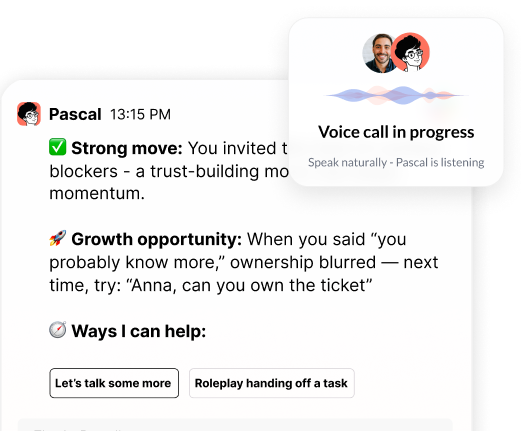
Pascal demonstrates this through proactive follow-up after every meeting. Rather than waiting for managers to remember to seek coaching, the system delivers specific feedback within minutes of interactions. A manager might receive a nudge like: "Strong move inviting the team to surface blockers. Growth opportunity: when you said 'you probably know more,' ownership blurred. Try: 'Anna, can you own the ticket?'" This immediate, contextual feedback creates learning loops that transform behavior far faster than annual training programs.
AI coaching excels for foundational management skills that most managers need but few receive adequate support to develop, while human coaches remain essential for complex organizational dynamics and sensitive HR topics. AI coaching democratizes access by costing 1/20th to 1/100th of human coaching, making it feasible to support every manager rather than just executives. Blended models combining AI for routine skill development and human coaches for complex situations deliver better outcomes than either approach alone.
Purpose-built platforms include escalation protocols that recognize when situations require HR expertise or legal consideration. Pascal automatically escalates sensitive topics like potential harassment, terminations, or mental health concerns to appropriate human experts. This protective layer ensures that AI coaching extends manager capability without creating organizational risk.
| Manager Development Need | Best Approach | Why |
|---|---|---|
| Feedback, delegation, 1:1 skills | AI coaching | Routine, high-frequency, benefit from continuous practice |
| Performance management, goal-setting | AI coaching | Structured frameworks, benefit from real-time application |
| Terminations, harassment, legal issues | Human expertise | Require compliance, legal awareness, HR oversight |
| Complex organizational politics | Human coaches | Require contextual knowledge, strategic judgment |
| Career transitions, succession planning | Hybrid model | AI for skill development, human for strategic guidance |
Key Insight: The most effective organizations don't choose between AI and human coaching. They design blended models where AI handles the high-frequency, skill-building interactions while human coaches focus on complex, high-stakes situations requiring nuanced judgment.
The difference between effective AI coaching and overhyped solutions comes down to five critical factors that directly predict adoption and business impact. Purpose-built coaching expertise grounded in people science ensures guidance that managers trust and apply. Research from The Conference Board confirms that AI can provide up to 90% of day-to-day coaching functions, with 96% of users reporting customized coaching experiences.
Deep contextual awareness of your people and their work eliminates friction and drives sustained engagement. When managers don't need to repeatedly explain situations, they actually use the tool consistently. Organizations like HubSpot, Zapier, and Marriott are succeeding with AI coaching because they prioritize cultural alignment and real-time support over generic features.
Proactive engagement that surfaces guidance before managers realize they need it creates consistent development habits. Rather than waiting for managers to remember to seek help, effective systems identify coaching moments and deliver relevant insights automatically. When managers receive proactive guidance after meetings and interactions, they develop skills 2-3 times faster than those relying on reactive support.
Seamless workflow integration meets managers in the tools they already use dozens of times daily. Coaching that requires opening a separate application faces adoption barriers that separate platforms rarely overcome. The future of leadership development is embedded in daily workflows, not separated from work.
Appropriate guardrails for sensitive topics protect both organizations and employees while maintaining psychological safety. Platforms that escalate harassment, termination, and mental health concerns to HR expertise ensure that AI coaching enhances rather than complicates compliance and risk management.
"If we can finally democratize coaching, make it specific, timely, and integrated into real workflows, we solve one of the most chronic issues in the modern workplace." — Melinda Wolfe, former CHRO at Bloomberg, Pearson, and GLG
Organizations implementing purpose-built AI coaching see measurable improvements across multiple dimensions that matter to CHROs. **83% of direct reports report measurable improvement in their manager's effectiveness** after their leaders engage with AI coaching. Among highly engaged users, **manager Net Promoter Score increases by an average of 20%** within 90 days. These aren't engagement metrics; they're behavioral improvements confirmed by the people being managed.
Time savings compound quickly at scale. One technology company with 50 employees using Pascal estimated saving **150 hours** in their initial rollout. These time savings stem from eliminating redundant coaching requests, reducing the need for managers to search for relevant resources, and decreasing escalations to HR for routine management questions that AI coaching handles effectively.
Performance review quality improves when every manager has access to coaching on feedback delivery, goal-setting, and development planning. Rather than wide variance in review quality based on manager experience and natural coaching ability, AI coaching establishes a consistently high floor. Organizations that embed AI coaching into their performance management processes see dramatic improvements in review consistency and developmental impact.
"It makes it easier not to make mistakes. And it gives you frameworks to think through problems before you act." — Melinda Wolfe, on the practical value of AI coaching for managers
Evaluating vendors requires assessing five critical dimensions that predict whether the platform will drive adoption and business impact. Ask whether the system is purpose-built for coaching with behavioral science backing, or a repurposed consumer AI tool. Generic language models offer broad knowledge but lack the specialized frameworks that drive leadership development.
Assess contextual awareness capabilities. Does the platform integrate with your HR data, performance reviews, and communication patterns to understand each manager's specific situation? Systems that require managers to repeatedly explain background information create friction that kills adoption. Those that integrate deeply with your existing systems eliminate this barrier.
Evaluate the engagement model. Does the coaching proactively surface guidance, or does it wait for managers to ask questions? Platforms that identify coaching moments and deliver relevant insights automatically create consistent habits that drive long-term growth.
Confirm workflow integration. Does the coaching meet managers where they work, or does it require adopting another platform? The best solutions live inside Slack, Teams, and meeting tools rather than demanding adoption of new interfaces.
Verify sensitive topic handling. Does the platform include appropriate guardrails and escalation protocols? Systems without proper boundaries introduce legal risks when they provide guidance on terminations, harassment, or other issues requiring human expertise.
The difference between effective AI coaching and overhyped solutions comes down to whether the platform combines purpose-built coaching expertise with deep contextual awareness, proactive engagement, seamless workflow integration, and appropriate guardrails for sensitive topics. Pascal combines all five elements to deliver coaching that managers actually trust and use consistently. The result is faster manager ramp time, higher quality feedback conversations, improved performance review consistency, and measurable behavior change that traditional training programs struggle to achieve.

.png)
.webp)
“Thank you for setting the great foundation for my promotion; now I have a plan!"

Curious to see how AI Coaching can 10X the impact and scale of your development initiatives. Book a demo today for: