

Proactive AI coaching drives measurably better adoption, retention, and behavior change than reactive models that wait for managers to ask for help. The answer is clear: proactive platforms maintain 75%+ regular usage versus 51% for on-demand tools, with managers using proactive systems averaging 2.3 coaching sessions per week and achieving 94% monthly retention. The difference determines whether coaching becomes a daily habit or remains sporadic crisis support.
Quick Takeaway: Proactive AI coaching surfaces guidance before managers realize they need it, delivering feedback within minutes of key moments while context is fresh. This approach eliminates friction, creates consistent habits, and drives the 40% higher retention and 60% faster goal achievement that reactive models simply cannot match.
Proactive coaching surfaces guidance before managers realize they need it—after meetings, before difficult conversations, during organizational rituals—while reactive models require managers to recognize problems and initiate contact. The difference determines whether coaching becomes a daily habit or remains sporadic crisis support.
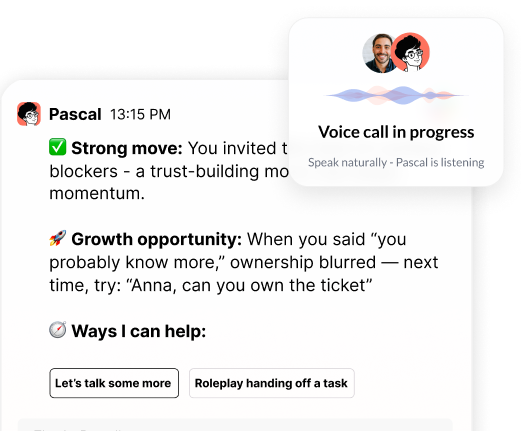
Proactive systems observe work patterns and trigger coaching at natural moments when learning sticks. A manager completes a one-on-one conversation and immediately receives feedback: "Strong move inviting Sarah to surface blockers. Growth opportunity: When you said 'you probably know more,' ownership blurred. Next time, try: 'Sarah, can you own this?'" The coaching arrives while context is fresh and the manager can immediately apply learning to their next interaction.
Reactive tools create friction at every step. Managers must remember the tool exists, navigate to it, explain context, and wait for response. By the time reactive coaching arrives, the coaching moment has passed and the manager has moved to the next crisis. Proactive engagement eliminates activation energy that kills adoption in passive tools, making coaching feel like a natural part of work rather than an additional burden.
Managers don't fail to use coaching because they lack motivation; they fail because they're overwhelmed and remembering to seek help ranks low on their priority list. Proactive systems meet managers in existing workflows at moments when guidance is most actionable.
Proactive platforms maintain 75%+ regular usage versus 51% for on-demand tools, with monthly retention reaching 94% compared to 20-30% for on-demand models. Managers using proactive systems average 2.3 coaching sessions per week, indicating habit formation. Workflow integration into Slack and Teams eliminates the context-switching that kills adoption; adoption rates jump from 30% for standalone portals to 60-75% for embedded solutions.
Coaches using AI-powered proactive outreach report 40% higher client retention and 60% faster goal achievement compared to reactive models. This isn't marginal improvement—it's the difference between a tool that transforms manager effectiveness and one that collects digital dust.
Effective AI coaches proactively surface guidance after meetings while context is fresh, before scheduled difficult conversations, during performance review season, and when behavioral patterns suggest a development opportunity—but never on sensitive topics.
After team meetings or one-on-ones, immediate feedback while context is fresh creates highest learning impact. Before performance reviews, goal-setting cycles, and other predictable high-stress moments, proactive coaching addresses challenges when managers most need support. When patterns emerge—a manager consistently struggling with delegation or avoiding conflict—proactive nudges surface the pattern while it's still forming. Organization-specific triggers matter too: when your performance review season begins, Pascal can proactively offer help writing reviews and preparing conversations.
Never should an AI coach initiate on sensitive topics like harassment, medical issues, terminations, or mental health concerns. These always escalate to HR with guidance on preparation.
Research demonstrates that proactive approaches achieve 40% higher client retention and 60% faster goal achievement compared to reactive models. The Conference Board shows AI can provide up to 90% of day-to-day coaching functions, with particular strength in continuous feedback, nudges, and personalized learning recommendations—all inherently proactive capabilities.
Organizations embedding coaching into daily workflows see adoption above 80% within the first month. Proactive feedback after every meeting creates automatic behavior patterns that replace old habits over time. 83% of direct reports see measurable improvement in their manager with proactive engagement. Habit formation requires consistent repetition at predictable intervals; proactive systems create this consistency while reactive tools depend on managers initiating contact inconsistently.
| Metric | Proactive Model | Reactive Model |
|---|---|---|
| Regular usage rate | 75%+ | 51% |
| Monthly retention | 94% | 20-30% |
| Sessions per week | 2.3 average | Less than 1 |
| Colleague-reported improvement | 83% see improvement | Varies by engagement |
Pascal combines purpose-built coaching expertise, contextual awareness of your people and their work, proactive engagement in Slack and Teams, and robust guardrails for sensitive topics. The result: coaching that feels like a trusted companion, not another tool to remember.
Pascal joins meetings to observe team dynamics and delivers real-time feedback immediately afterward in Slack. Proactive check-ins surface growth opportunities based on observed patterns in communication and decision-making. Integration into existing tools eliminates adoption friction; managers access coaching without context-switching. Escalation protocols ensure sensitive topics involving mental health, harassment, or terminations route to HR while helping managers prepare.
Weekly development nudges keep growth front-of-mind without overwhelming managers. This proactive approach creates the consistent engagement that drives behavior change. Managers don't need to remember to seek coaching. The coaching finds them at exactly the moment when the experience is fresh and the learning opportunity is highest.
Key Insight: The organizations scaling manager effectiveness fastest aren't those waiting for managers to seek coaching. They're those where coaching finds managers at exactly the moment when the experience is fresh and the learning opportunity is highest.
Habit formation requires consistent repetition at predictable intervals. Proactive systems create this consistency through repeated practice and reinforcement, while reactive tools depend on managers initiating contact inconsistently.
Weekly development nudges keep growth front-of-mind without overwhelming managers. Consistent practice with immediate feedback accelerates skill development 2-3 times faster than crisis-only support. Managers develop skills through repeated application in real work contexts rather than one-time learning events. Proactive feedback after every meeting creates automatic behavior patterns that replace old habits over time.
On-demand tools see engagement drop to less than one session per month after initial novelty fades because friction compounds at each decision point. A manager who receives feedback in Slack within minutes of a one-on-one conversation acts on it immediately. One who must log into a separate platform three days later has moved to the next crisis.
"So much of the real learning and value that comes from this comes from in context coaching in the moment to drive performance and to solve problems in the moment."
The organizations scaling manager effectiveness fastest aren't those waiting for managers to seek coaching. They're those where coaching finds managers at exactly the moment when the experience is fresh and the learning opportunity is highest.
Proactive coaching eliminates the friction that kills adoption in passive tools. Habit formation happens through consistent, contextual guidance, not crisis-only support. Purpose-built systems grounded in coaching expertise deliver guidance managers trust and apply immediately. Workflow integration determines whether coaching becomes habit or remains aspiration.

.png)
.webp)
“Thank you for setting the great foundation for my promotion; now I have a plan!"

Curious to see how AI Coaching can 10X the impact and scale of your development initiatives. Book a demo today for: