
Proactive AI coaching drives 40% higher client retention and 60% faster goal achievement compared to reactive models that wait to be asked. The difference comes down to timing, context, and habit formation. Managers rarely seek help in moments of crisis; they need guidance before problems escalate, when they're most receptive to change.
Quick Takeaway: Proactive AI coaching that initiates contact based on observed patterns drives measurably better adoption, engagement, and behavior change than reactive tools. Research shows proactive systems achieve 40% higher retention rates and 60% faster goal achievement. The key is timing guidance to moments when managers are most receptive and when insights drive immediate action.
At Pinnacle, we've learned this distinction through building Pascal, our AI coach, and working with hundreds of organizations. The platforms that transform manager effectiveness aren't the ones waiting for managers to remember they exist. They're the systems that deliver guidance at the exact moment it matters most, in the tools managers already use, based on actual work dynamics rather than generic frameworks.
Proactive AI coaching that initiates contact based on observed patterns drives measurably better adoption, engagement, and behavior change than reactive models. Coaches using AI systems that proactively identify disengagement and trigger re-engagement sequences report 40% higher client retention rates and 60% faster goal achievement. The impact extends beyond engagement metrics to actual client satisfaction and support efficiency.
In one coaching practice, proactive AI monitoring reduced support inquiries by 50% while increasing client satisfaction scores by 40%. This isn't about automation replacing human support. It's about making human expertise more strategic by handling routine touchpoints and flagging situations requiring intervention.
Pascal exemplifies this through proactive engagement that bridges gaps between formal coaching sessions. Rather than waiting for managers to ask questions, Pascal joins meetings, delivers real-time feedback in Slack and Teams, and surfaces growth opportunities based on observed patterns. AI can bridge gaps between coaching sessions by reinforcing accountability and helping managers translate insights into action. This continuous support creates the consistent practice that turns knowledge into sustained behavior change.
Proactive AI coaches surface guidance before managers realize they need it, creating consistent development habits. Reactive tools miss critical moments because managers don't always know what they don't know, leaving skill gaps unaddressed until they become performance problems.
The difference shows up in engagement patterns. Pascal maintains 94% monthly retention with 2.3 average coaching sessions per week, engagement levels that reflect genuine utility rather than forced adoption. Managers who receive proactive nudges develop skills 2-3 times faster than those who only seek coaching reactively. This acceleration happens because proactive systems deliver feedback immediately after triggering events, when context is fresh and the motivation to improve is highest.
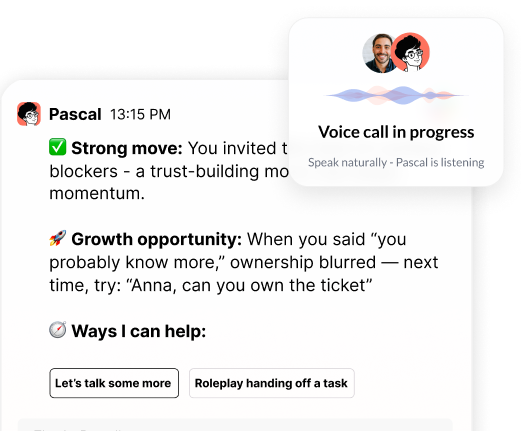
Reactive models create friction at every step. A manager struggling with delegation needs to remember the platform exists, navigate to it, articulate their situation clearly, and wait for a response. By then, the moment has often passed. Proactive coaching eliminates this activation energy by meeting managers where they work, in the flow of daily interactions. When a manager completes a team meeting, Pascal surfaces specific feedback within minutes: "Strong move inviting the team to surface blockers. Growth opportunity: When you said 'you probably know more,' ownership blurred. Next time, try: 'Anna, can you own the ticket?'"
Managers using proactive coaching report 20% average lift in Manager Net Promoter Score. More importantly, 83% of colleagues see measurable improvement in their manager when coaching is continuous and contextual rather than episodic and generic.
Effective proactive systems use multi-layered triggers: observed communication patterns, meeting dynamics, performance data, and calendar-based moments like performance reviews or goal-setting periods. The key is timing guidance to moments when managers are most receptive and when insights drive immediate action.
Proactive AI monitors engagement patterns, attendance, assignment completion, and sentiment to predict intervention opportunities. Pascal uses this contextual awareness to surface coaching at natural workflow moments. After team meetings, the system analyzes communication patterns and team dynamics to identify growth opportunities. Before performance reviews, Pascal prompts managers to prepare with structured guidance. During goal-setting periods, the system helps managers craft development plans tied to career aspirations.
Weekly check-ins based on development goals keep progress visible without overwhelming busy managers. The cadence matters as much as the content. Too frequent and coaching becomes noise. Too infrequent and momentum stalls. Purpose-built systems calibrate this balance based on individual engagement patterns and organizational context.
The triggers also distinguish between coaching opportunities and situations requiring escalation. When conversations touch on sensitive topics like terminations or harassment, proactive systems route to appropriate human expertise rather than attempting independent guidance. This boundary protection is what separates responsible AI coaching from tools that create legal liability.
Proactive engagement creates the consistent practice and habit formation that transforms knowledge into sustained behavior change. On-demand tools require managers to remember, navigate to the platform, and articulate their situation—friction that prevents most from seeking help until crises force action.
Behavioral science explains this pattern. Habit formation requires consistent touchpoints and immediate reinforcement. When a manager practices giving feedback with proactive coaching support, receives feedback on that practice, and then applies the learning in real situations, the behavior becomes automatic. On-demand models break this loop by requiring managers to initiate every interaction. Most don't, defaulting instead to familiar patterns that may be ineffective.
Real learning happens in-context, solving problems in the moment, not in classrooms or separate learning platforms. As Jeff Diana, former CHRO at Atlassian and Calendly, explains, so much of the real learning and value comes from in-context coaching in the moment to drive performance and solve problems in the moment. Managers receiving proactive coaching develop skills faster because they practice continuously with immediate feedback, not because they're more motivated or capable.
Habit formation requires consistent touchpoints; proactive nudges create the repetition that builds automaticity. When coaching happens daily or weekly based on observed work patterns, managers develop new reflexes. When coaching requires remembering to seek it out, most never build the habit.
Proactive systems must include guardrails that escalate sensitive situations to human experts rather than attempting to coach through them independently. Moderation systems identify when conversations touch harassment, medical issues, or terminations, ensuring appropriate human oversight while maintaining the manager's sense of support.
Pascal's escalation protocols recognize sensitive employee topics and route to HR rather than providing independent guidance. When a manager discusses potential termination, the system helps them prepare for conversations with HR while repeatedly recommending connection with appropriate expertise. When queries touch on harassment or discrimination, Pascal escalates immediately, suggests relevant resources, and flags the issue for investigation.
This approach de-risks AI adoption by ensuring appropriate human expertise gets involved when it matters most. Managers understand that certain topics require human judgment, and they appreciate guidance that helps them prepare for those conversations. Guardrails protect organizations from the worst-case scenario: managers acting on AI advice in situations requiring legal or HR expertise.
Clear escalation also builds trust because managers understand AI knows its boundaries. Rather than worrying that the system will give bad advice on sensitive topics, they know it will direct them to appropriate support. This transparency transforms proactive coaching from something that feels intrusive into something that feels protective.
Proactive coaching works best for foundational management skills (feedback, delegation, one-on-ones) and routine development moments. Reactive support remains valuable for deep-dive scenarios, complex interpersonal situations, and strategic career guidance requiring human judgment.
Start with high-frequency, routine coaching moments where proactive triggers create obvious value. If your biggest challenge is improving feedback quality and frequency, proactive coaching that prompts preparation before one-on-ones and surfaces feedback opportunities after meetings delivers immediate impact. If your problem is inconsistent performance reviews, proactive guidance during review season helps managers prepare and write more effectively.
Reserve reactive access for managers seeking guidance on nuanced, complex, or sensitive situations. Hybrid models combining proactive daily guidance with reactive access for edge cases outperform either approach alone. Proactive coaching democratizes access to development that was previously available only to executives. Integration into existing workflows (not separate platforms) determines whether proactive engagement becomes habit or annoyance.
The sequencing matters. Organizations that begin with proactive coaching for foundational skills build manager confidence and engagement. As managers experience value from routine coaching, they become more willing to seek reactive support for complex situations. The flywheel effect doesn't happen when you start with on-demand only.
Pascal's approach demonstrates this layering. Proactive coaching handles daily development moments—preparation for meetings, feedback after interactions, goal progress check-ins. Managers can always ask questions reactively in Slack or Teams. When sensitive topics arise, the system escalates to HR while continuing to provide support within appropriate boundaries. This combination creates a coaching experience that's both continuous and safe.

.png)
.webp)
“Thank you for setting the great foundation for my promotion; now I have a plan!"

Curious to see how AI Coaching can 10X the impact and scale of your development initiatives. Book a demo today for: